

Research Progress
SIA Researchers Advance Precise Manipulation and Single-Cell Mechanical Measurement Using Surface Acoustic Waves
Ultrasound offers advantages such as non-contact actuation, good biocompatibility, and ease of chip integration, giving it broad application prospects in microparticle manipulation and cell mechanics research. Among related technologies, surface acoustic wave (SAW) technology can construct tunable acoustic fields within microfluidic chips to achieve precise positioning and controllable force loading of microparticles.
However, direct experimental calibration of acoustic radiation force remains challenging, limiting its application in quantitative single-cell mechanical measurements. How to accurately determine the force applied to cells while precisely manipulating microparticles is an important prerequisite for achieving quantitative single-cell mechanical measurements.
To address this issue, a research team from the State Key Laboratory of Robotics and Intelligent Systems at the Shenyang Institute of Automation(SIA), Chinese Academy of Sciences, has further constructed a microneedle–microsphere force-sensing probe. The work was published in the international journal Acta Biomaterialia under the title Accurate control of microspheres by surface acoustic waves for quantitative force characterization and cell mechanics measurement.QU Hengchao, a doctoral student at the SIA is the first author, and Professor LIANG Wenfeng from Shenyang Jianzhu University and Researcher LIU Lianqing from SIA are the corresponding authors.
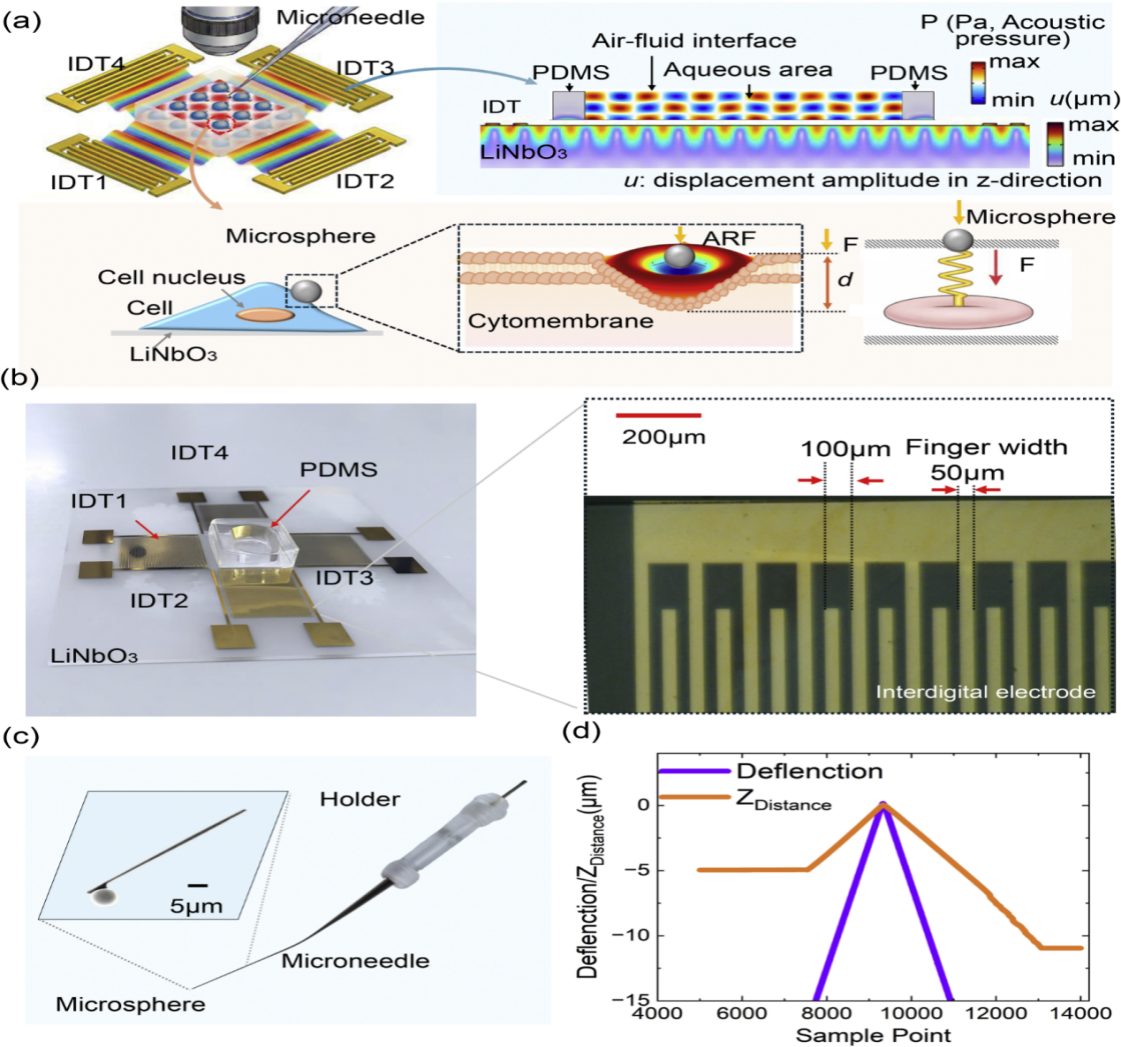
Schematic of SAW-Driven Microsphere Manipulation, Quantitative Force Calibration and Cellular Micromechanical Characterization (Image by SIA)
The researchers used a calibrated atomic force microscope (AFM) cantilever to calibrate the stiffness of the microneedle, and directly measured the acoustic radiation force acting on the microsphere by recording the elastic deflection of the microneedle under the acoustic field, thereby establishing the correspondence between the experimental phase and the applied force. This method transforms acoustic radiation force from a model-estimated quantity into a physical quantity that can be directly measured and experimentally calibrated, providing a basis for controllable force loading at the picoNewton to nanoNewton scale.
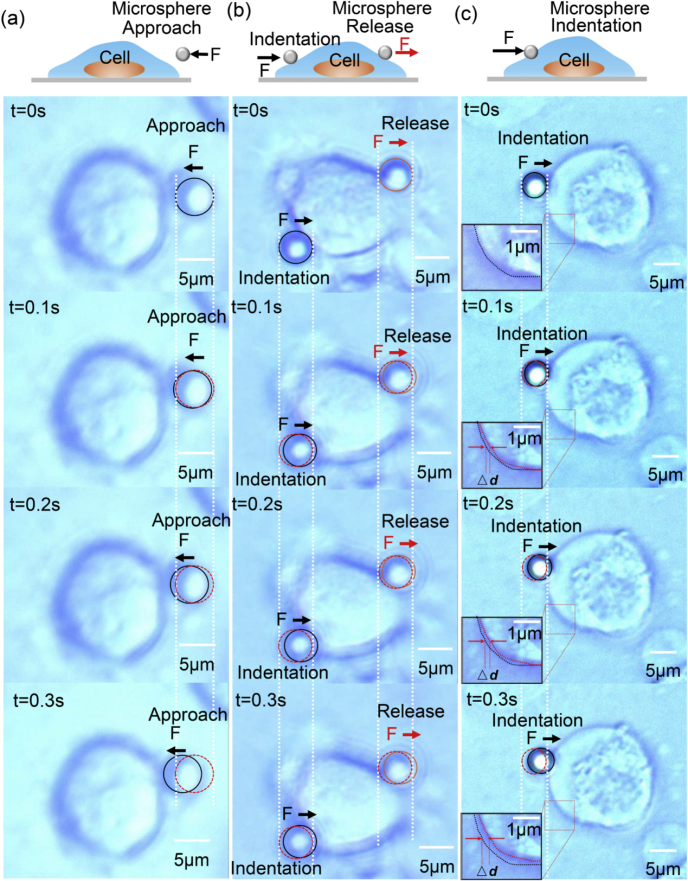
Acoustic radiation force drives the interaction between microspheres and the cell membrane, inducing local membrane deformation (Image by SIA)
On this basis, the research team used the acoustic field to drive 5-μm-diameter silica microspheres to perform local indentation experiments on adherent C2C12 myoblasts. By adjusting the phase to control the approach, indentation, and withdrawal of the microspheres, and combining real-time microscopic imaging to record cell deformation, they achieved single-cell local mechanical measurement under remote acoustic-field actuation. Experiments showed that the corresponding indentation deformation disappeared after the microspheres were withdrawn, indicating that cell deformation was reversible under the tested conditions.
This research established an experimental method integrating microsphere manipulation, acoustic radiation force calibration, and single-cell mechanical measurement, expanding the application of SAW technology in quantitative cell mechanics research. With phase-programmable manipulation and chip-integration potential, the platform is expected to be further applied to studies of local mechanical differences, mechanotransduction, and dynamic responses of cells, and to provide a technical foundation for future automated, parallel multi-cell mechanical analysis.

