

Research Progress
SIA Researchers Propose LiMTrack: Mamba-Based Visual Tracking with Long-Term Temporal Modeling
General visual object tracking technology holds broad application prospects in numerous industrial scenarios, including autonomous driving and road surveillance. Given the initial state of a target, object tracking methods can infer and predict the target’s position in subsequent video streams, thereby determining its motion trajectory.
Most existing tracking algorithms commonly adopt a template-matching paradigm. This means that recognition in many scenarios poses challenges—such as target deformation and occlusion—where the initial template can hardly match the current target, leading to tracking failure. Recent trackers have gradually incorporated temporal information from previous frames, but they still suffer from the loss of early temporal information.
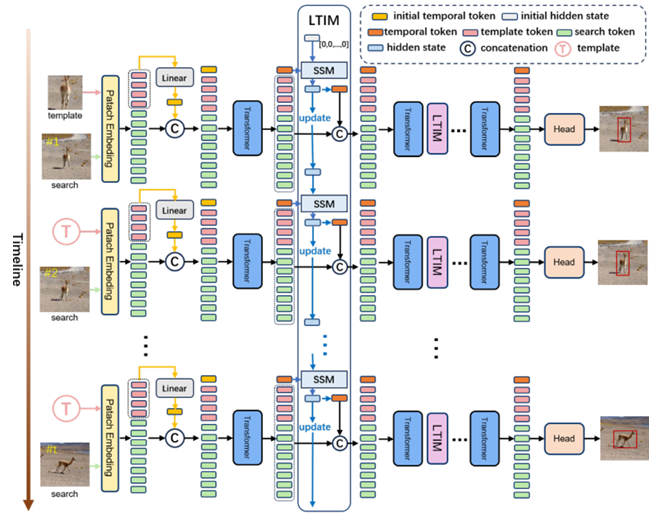
Overall network architecture of the novel general-purpose object tracking framework (Image by SIA)
To address these issues, a research team from the Opto-Electronic Information Technology Department of the Shenyang Institute of Automation(SIA), Chinese Academy of Sciences (SIA), the Chinese Academy of Sciences has proposed a novel tracking framework that leverages long-term temporal information, named LiMTrack.The work was published in the international journal Knowledge-Based Systems under the title LiMTrack: Mamba-based long-term temporal information propagation for visual object tracking. The first author is Master student BAO Yiming from the SIA, and Researcher LIU Yunpeng is the corresponding author.
The LiMTrack method designs an LTIM module based on the Mamba model. Essentially a state space model, it accepts feature information from each frame as input, fuses it with recorded historical hidden states and passes it to the next frame, while outputting features fused with historical prior information to guide tracking in the current frame. This module propagates the temporal information of each frame frame by frame, enabling effective utilization of long-term context starting from the first frame. It solves the problem of insufficient long-term temporal information utilization in existing trackers and can effectively cope with challenges such as target deformation.
Meanwhile, LiMTrack designs an interleaved modeling backbone network. Rather than following the conventional temporal tracker approach of propagating temporal information only at the end of the backbone, it inserts LTIM modules at multiple depths within the backbone network to propagate temporal information at different depths. Temporal guidance at different depths makes the target features acquired by the model more sufficient and comprehensive, further improving tracking performance.
The research team tested the method on multiple general visual object tracking benchmarks, including GOT-10k, LaSOT, and LaSOText. The results showed that the method achieved leading performance on multiple benchmarks compared with recent methods. On the GOT-10k dataset, it achieved an average overlap (AO) of 76.0%. In addition, in efficiency–performance trade-off comparisons, compared with Transformer-based temporal modeling methods, LiMTrack significantly reduced the number of parameters and improved tracking speed by 30 FPS while also achieving a certain improvement in tracking accuracy.
This research combines a Vision Transformer for modeling image features with Mamba for modeling temporal features. The two perform their respective functions and leverage their respective advantages, providing a technical approach for general visual object tracking methods to utilize long-term temporal information.

