

Research Progress
SIA Researchers Make Progress in Domain-Generalized Object Detection
Object detection technology can identify the categories of target objects in images and localize their spatial positions, serving as a key foundational technology in fields such as autonomous driving, robot perception, and intelligent surveillance. However, in real-world scenarios, factors such as weather conditions, illumination intensity, and imaging device differences readily cause data distribution shifts, leading to missed detections and false detections and severely constraining practical performance.
How to train models on existing scenario data and improve their adaptability to unknown environments is an important issue for enhancing the practical application capability of visual systems. A research team from the State Key Laboratory of Robotics and Intelligent Systems at the Shenyang Institute of Automation(SIA), Chinese Academy of Sciences, has proposed a cross-modality causal-aware hierarchical representation learning framework, named HierarchicalDG.
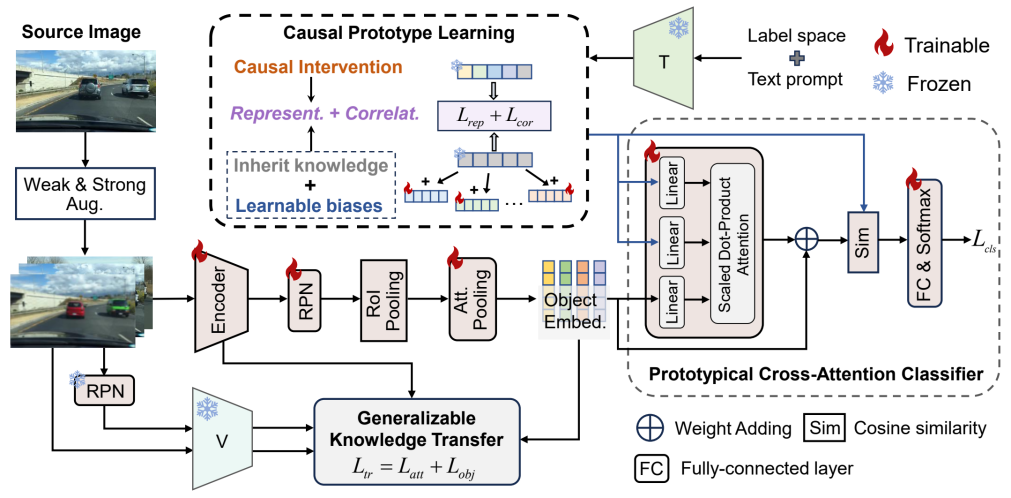
HierarchicalDG: Cross-Modal Causal-Aware Hierarchical Representation Learning (Image by SIA)
The framework constructs a hierarchical learning pathway of “image features—scene attention—object representations—visual sub-prototypes—causal prototypes,” progressively refining and transferring knowledge from vision-language models. The related work was published in the international journal IEEE Transactions on Pattern Analysis and Machine Intelligenceunder the title Cross-Modality Causal-aware Hierarchical Representation Learning for Domain Generalized Object Detection. The first author of the paper is doctoral student LIU Yajing from the SIA, and the corresponding authors are Researcher TIAN Jiandong from the SIA and Professor Baojie Fan from Nanjing University of Posts and Telecommunications.
The framework uses textual semantics as causal intervention signals to learn visual prototypes with stable semantic structures while maintaining intra-class feature diversity. Leveraging a prototype mechanism to guide the object classification process, it transfers category-level causal invariance to object and scene representations, thereby improving the model’s robustness to data distribution shifts. Experimental results showed that the framework achieved strong cross-scenario generalization performance across five benchmark tasks: multiple weather variations, image perturbations, real-to-artistic image transfer, cross-camera settings, and simulation-to-reality transfer. Moreover, the inference stage does not require invoking the vision-language model branch, balancing cross-scenario generalization performance with inference efficiency.
The team further conducted extended validation on semantic segmentation and object tracking tasks, verifying the cross-task applicability of the learning paradigm and providing a new technical approach for improving the generalization capability of visual perception models in complex environments.

