

Research Progress
Active Vibration Control for Space Deployable Structures: A New Method for ROSA
With the continuous development of large-scale solar panels, space antennas, drag sails, and other aerospace structures towards lightweight and large-scale designs, the CFRC-DCR has become an important supporting component due to its high specific strength, high strain energy storage capability, and self-deployment characteristics.
However, this type of structure has thin walls, high flexibility, and low damping, and is prone to sustained low-frequency vibrations under thermal shock, attitude maneuvers, and external disturbances, thereby affecting the pointing accuracy and on-orbit stability of spacecraft. How to establish a high-fidelity dynamic model and achieve reliable vibration suppression under complex disturbances is a key challenge in engineering applications.
Recently, the research team from the Center for Space Automation Technology & Systems of the Shenyang Institute of Automation(SIA), Chinese Academy of Sciences, has made research progress in the dynamic modeling and active vibration control of Carbon Fiber Reinforced Composite Deployable C-shaped Rods (CFRC-DCR). The related results were published in the international journal Composite Structures.

Roll‑Out Solar Array (Image by SIA)
Aiming at the problem that low-frequency vibrations of Roll-Out Solar Arrays (ROSA) are difficult to accurately model and effectively suppress, this study proposed a hybrid control method combining a Colored Noise Augmented Kalman Filter (CNAKF) with LQR feedforward, providing a new idea for vibration suppression of space deployable structures.
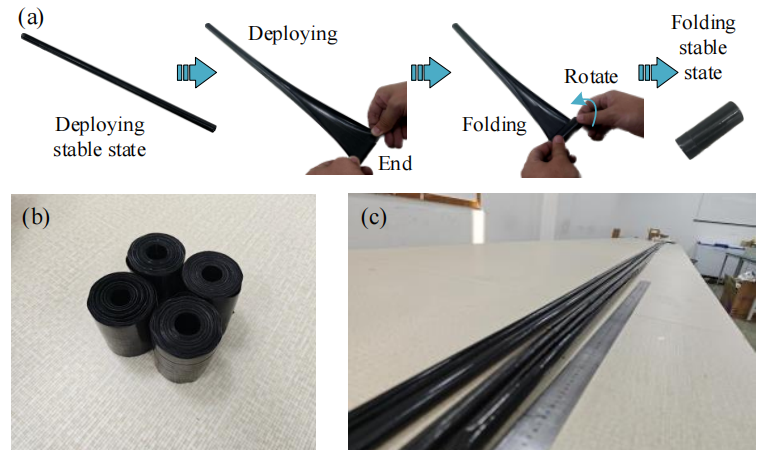
Rollable and elastically deployable Carbon Fiber Reinforced Composite Deployable C-shaped Rod (Image by SIA)
To address the issue of non-ideal boundary constraints, the research team established an electromechanically coupled dynamic model of CFRC-DCR integrated with Macro Fiber Composite (MFC) actuators and sensors based on the First-order Shear Deformation Theory (FSDT) and the artificial spring boundary technique. The team first simulated the ideal clamped boundary with extremely large spring stiffness. Compared with the finite element results, the maximum error of the first six natural frequencies was approximately 2.43%. Subsequently, the actual boundary stiffness was inversely identified through impact hammer modal testing, making the semi-analytical model more accurately reflect the real fixture elasticity. The experiment also used the PolyMAX method to identify the first six modal damping ratios, providing reliable parameters for subsequent control design.
In terms of state estimation, the team found that flexible space structures act like band-pass filters, and external disturbances often manifest as narrowband colored noise. Traditional Standard Kalman Filters (SKF) suffer from phase lag and amplitude attenuation. To this end, they proposed the Colored Noise Augmented Kalman Filter (CNAKF), which models the narrowband disturbance as a second-order driven process and augments it into the state vector, enabling the observer to simultaneously estimate system states and external disturbances. Simulations and experiments show that CNAKF outperforms SKF under both single-frequency and multi-frequency complex disturbances. It can not only track modal displacements more accurately but also reconstruct the disturbance voltage in real time, providing critical signals for feedforward compensation.
Based on the above estimation results, the team further constructed a hybrid controller combining LQR optimal feedback with disturbance feedforward, and conducted hardware-in-the-loop experiments on the Speedgoat real-time hardware platform. The experiment adopted a single sensing MFC and single actuating MFC architecture, validating the core control algorithm. The results show that under first- and second-order resonant excitations, the hybrid controller reduced the structural amplitude by 60.43% and 61.73%, respectively, significantly outperforming standalone feedforward control or standalone LQR control. In the frequency domain analysis, the hybrid control achieved band energy reductions of 84.97% and 90.22% under first- and second-order excitations, respectively, with resonant peak drops of 7.59 dB and 10.15 dB.
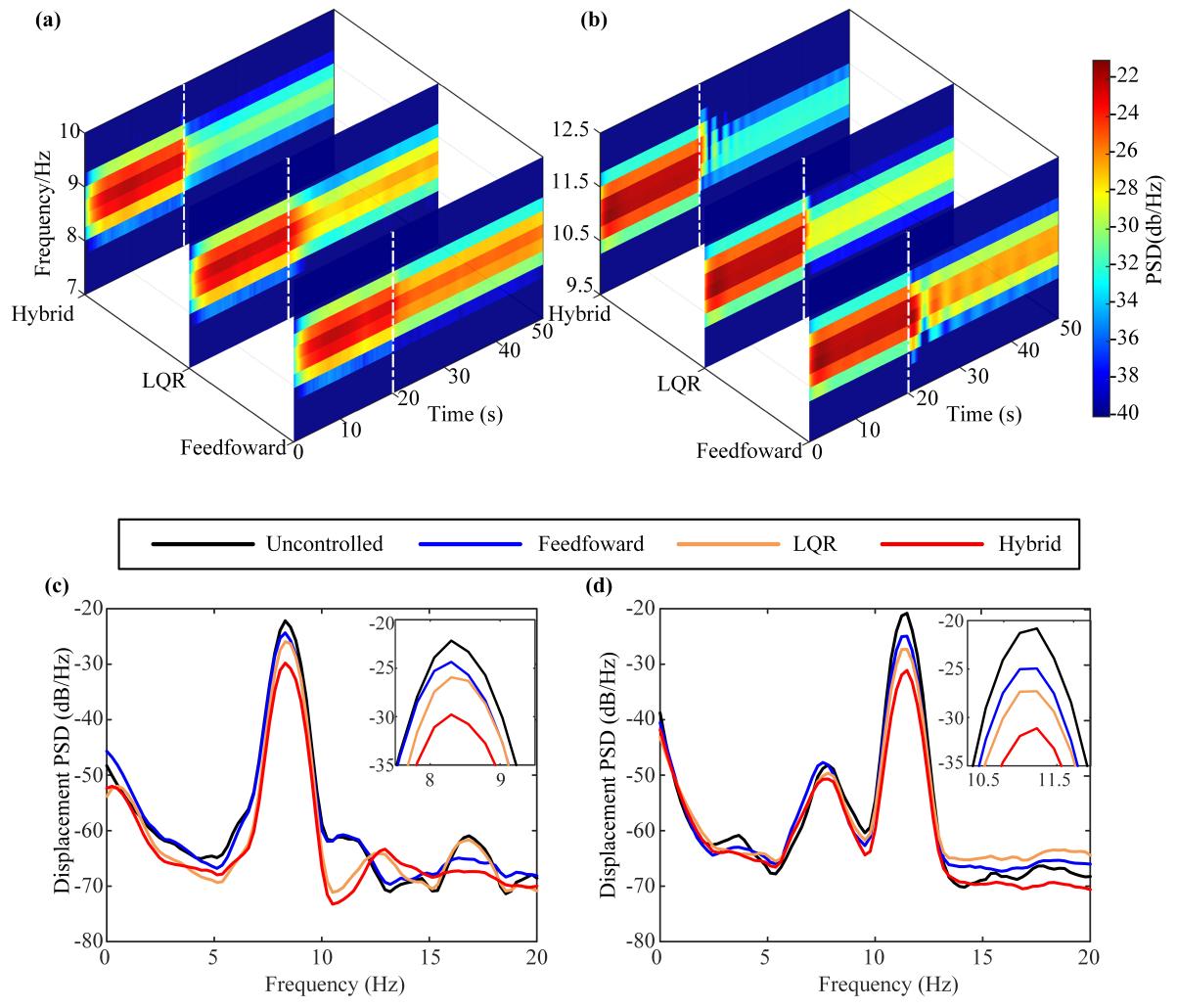
Frequency-domain vibration reduction effects under first- and second-order resonant excitations (Image by SIA)
In the dynamic variable amplitude and frequency experiment, the controller demonstrated good adaptive capability. When the disturbance amplitude suddenly increased by 1.4 times, the amplitude after control was still limited to 0.405 mm, with a suppression rate of 64.16%. When the disturbance frequency decreased by 0.8 Hz, the system quickly stabilized after a brief transition, with a suppression rate of 56.31%. Under 0-100 Hz band-limited white noise random excitation, the hybrid control reduced the displacement RMS from 0.0319 mm to 0.0130 mm, achieving an overall vibration energy reduction of approximately 59.18%, while the control voltage remained within the hardware safety range.
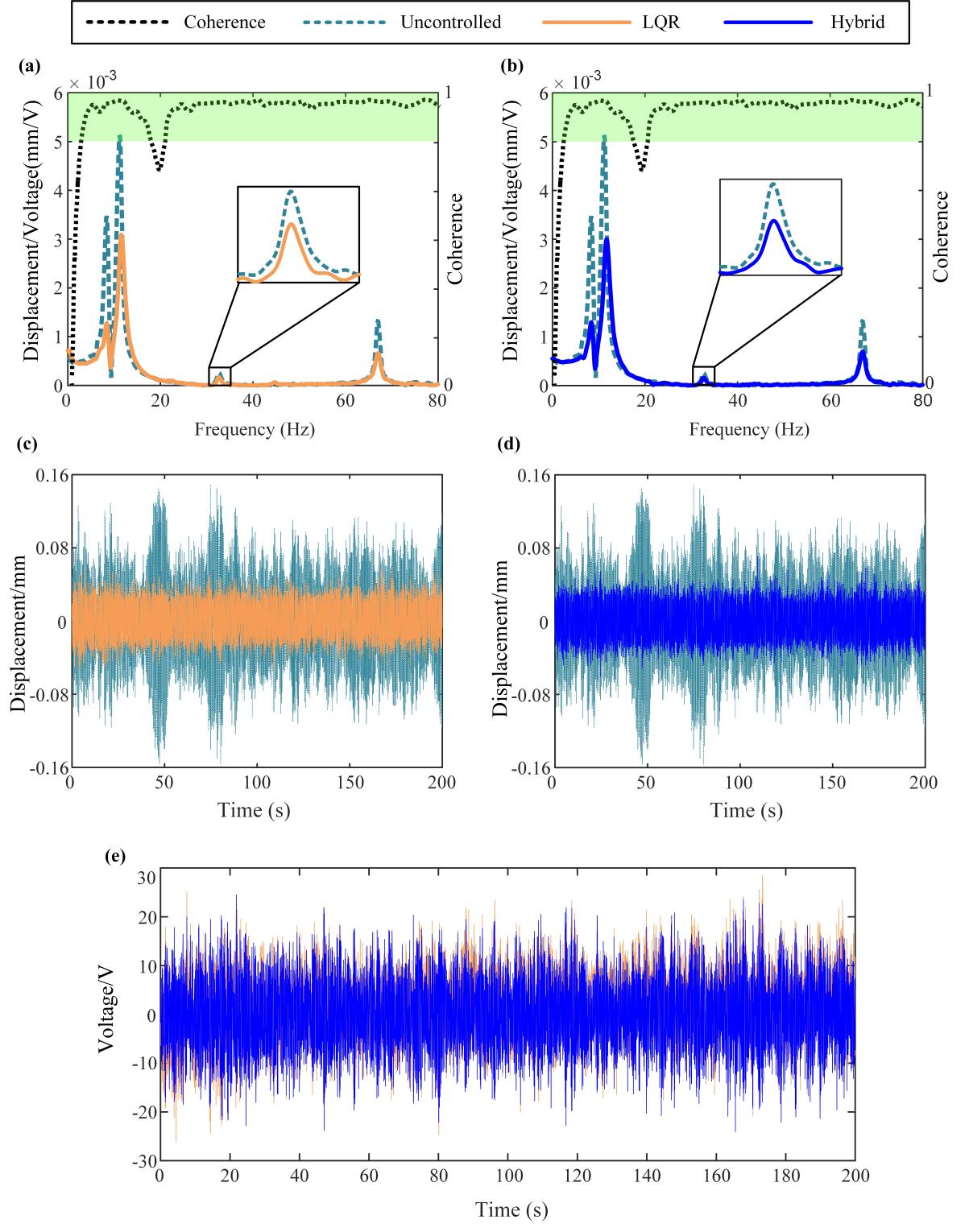
Multi-modal vibration reduction effects under 0-100 Hz band-limited white noise excitation (Image by SIA)
"This study establishes a complete methodological chain from high-fidelity modeling, state and disturbance estimation, to hybrid control verification, which can provide theoretical and technical references for vibration suppression of large flexible space deployable structures," said LUO Haitao. "In the future, we will continue to focus on extreme operating conditions such as large amplitude and strong nonlinearity, and further carry out research on nonlinear dynamic modeling and nonlinear active control."

