

Research Progress
U-Shaped Riemannian Manifold Network Advances Non-Invasive Brain-Computer Interface Decoding
Non-invasive brain-computer interfaces (BCIs) enable direct interaction between the human brain and external devices by decoding electroencephalogram (EEG) signals, holding broad application prospects in fields such as rehabilitation robots, neuroprostheses, and intelligent human-machine interaction.
However, existing manifold learning schemes often neglect the spatiotemporal coupling correlations among different EEG frequency bands, and the multi-level feature mapping process also causes attenuation of manifold structural information, constraining further improvements in decoding performance.
To address these challenges, a research team from State Key Laboratory of Robotics and Intelligent Systems has proposed a multiscale spatiotemporal convolution-integrated U-shaped Riemannian manifold learning neural network, named URCNet, which is suitable for EEG decoding and provides a new technical paradigm for EEG deep learning in non-Euclidean space. The related work was published in the international journal IEEE Transactions on Cognitive and Developmental Systems under the title A Novel U-shaped Riemannian Manifold Learning Neural Network for Motor Imagery EEG Decoding.
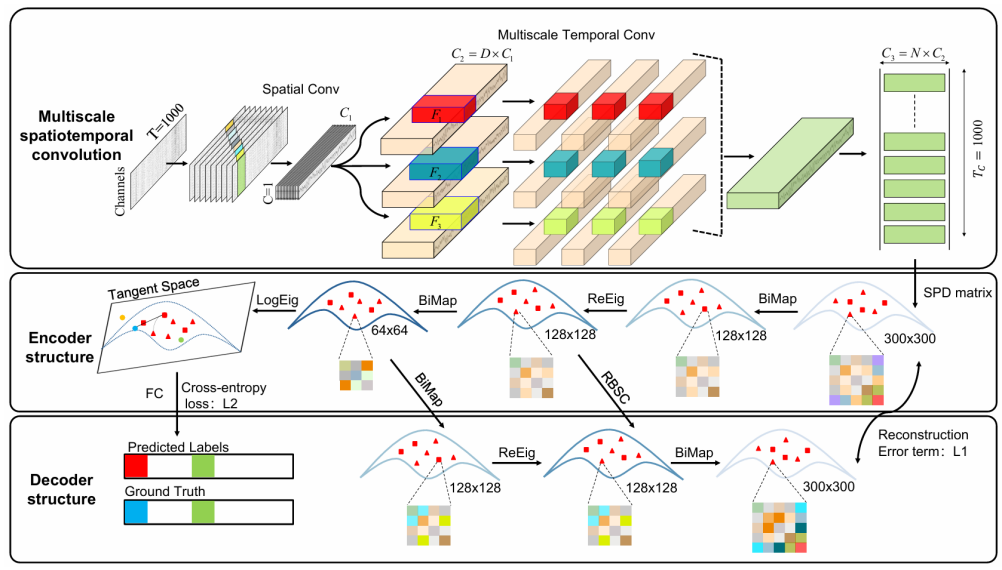
Schematic of the novel URCNet-based EEG decoding method (Image by SIA)
The URCNet method first uses multiscale spatiotemporal convolution to effectively extract local spatiotemporal dynamic coupling features of EEG. Inspired by the encoder-decoder structure, it then constructs a U-shaped Riemannian manifold learning network to capture global spatial dynamic information, thereby mitigating structural information degradation during the manifold mapping stage. Meanwhile, the team proposed a skip connection mechanism based on the Riemannian barycenter, which normalizes symmetric positive definite (SPD) matrices in non-Euclidean space to maintain the geometric structural stability of EEG features in the low-dimensional manifold space. Through joint optimization with an error reconstruction loss function, the discriminability of features is further enhanced.
The research team validated the method on the internationally used BCI Competition IV 2a, BCI Competition IV 2b, and Cho2017 datasets. The results showed that URCNet achieved decoding accuracies of 83.14%, 83.57%, and 71.83%, respectively, representing improvements of 5%–20% over mainstream network methods in recent years. In addition, the method exhibited excellent decoding performance under data conditions with different numbers of channels, different intention categories, and different subject scales.
This research combines the multiscale feature extraction capability of deep neural networks with the ability of Riemannian manifolds to learn geometric structures in non-Euclidean space, providing a new modeling approach for manifold learning frameworks for motor imagery EEG and helping to advance brain-computer interfaces from small-sample, low-robustness laboratory algorithms toward practical scenarios such as rehabilitation and disability assistance.
The first authors of the paper are DENG Chuan, a master's student, and WU Xuejian, a doctoral student at the SIA, and the corresponding authors are Associate Researcher CHU Yaqi and Researcher ZHAO Xingang. This research was supported by the National Natural Science Foundation of China, the National Key Research and Development Program, the Liaoning Provincial Future Industry Research and Development Program, the Shenyang Science and Technology Program, and other projects.

