

Research Progress
New Electrohydraulic Approach Enhances Propulsion and 3D Maneuverability of Soft Robotic Fish
Soft robotic fish hold broad application prospects in underwater environmental monitoring and resource exploration. However, their actuation performance and posture regulation capabilities remain limited, making it difficult to achieve both high-speed swimming and agile three-dimensional maneuvering. Balancing rapid propulsion with flexible 3D motion has therefore remained a key challenge in this research field.
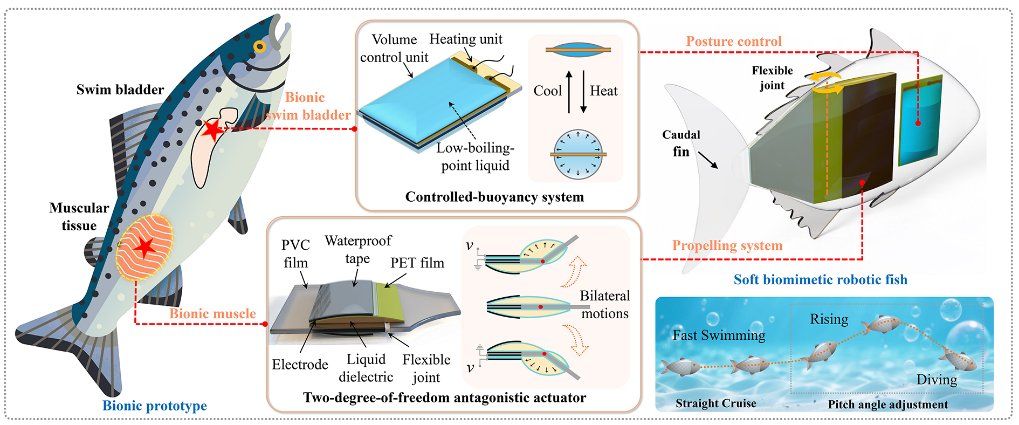
Biomimetic design and locomotion mechanism of the soft robotic fish (Image by SIA)
Recently, the bio-syncretic robotics research team at Shenyang Institute of Automation (SIA), Chinese Academy of Sciences, drew inspiration from the coordinated muscle–skeleton motion and swim-bladder-based buoyancy regulation mechanisms of fish. By incorporating fundamental behavioral mechanisms of living systems into soft robotic design, the team developed an electrohydraulically actuated soft robotic fish capable of high-speed swimming and three-dimensional maneuvering.
The robotic fish achieved both high-speed swimming and flexible three-dimensional maneuvering. The study, titled Electrohydraulic Actuated High-Speed Biomimetic Soft Robotic Fish with Flexible 3D Maneuverability, was published in IEEE/ASME Transactions on Mechatronics.
The research team designed a rigid‑flexible coupled two‑degree‑of‑freedom electrohydraulic actuator. Local rigid constraints reduce undesired deformation during actuation, while alternating motions of bilateral driving units mimic the antagonistic contraction of fish muscles and generates high‑frequency tail oscillations. Experimental results demonstrate that the robotic fish achieves a maximum swimming speed of 2.13 body lengths per second (approximately 26 cm/s), with a minimum cost of transport of 9.4 J/(kg·m). This sets a new speed record for BCF‑mode soft robotic fish.
Building on this capability, the team further developed a biomimetic swim‑bladder based on liquid‑gas phase transition. By regulating the local buoyancy of the robotic fish, the system generates a pitching moment and enables posture adjustment from −20° to 58°. Through the coordination between electrohydraulic propulsion and dynamic posture regulation, the robotic fish can perform diverse motions including horizontal cruising, turning, S‑shaped swimming, ascending, diving and spiral ascent, substantially enhancing its three-dimensional maneuverability.
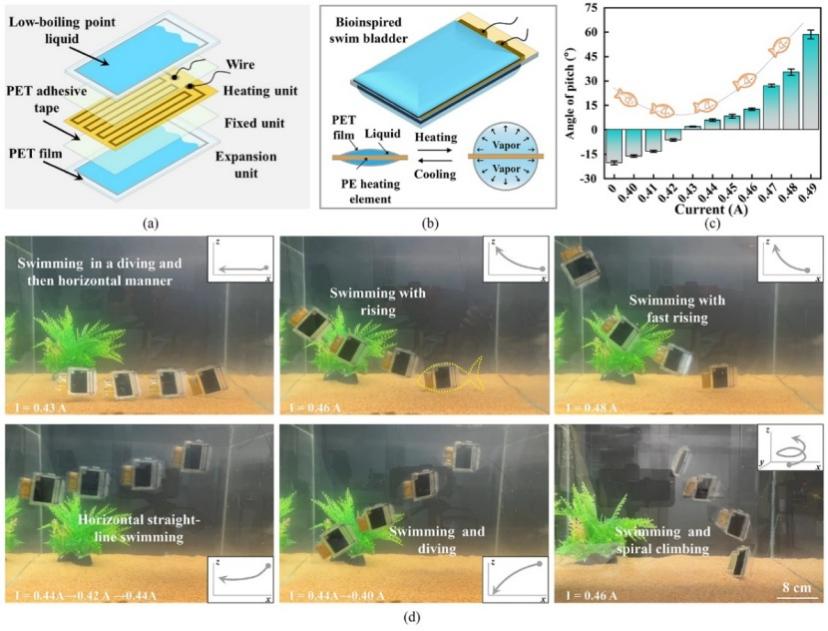
Posture regulation and 3D maneuvering of the biomimetic soft robotic fish (Image by SIA)
The proposed method combines rigid‑flexible coupled electrohydraulic propulsion with dynamic buoyancy regulation, enabling the soft robotic fish to retain structural compliance while achieving both high-speed propulsion and three-dimensional maneuverability. The approach provides a new approach for the design and motion control of high‑performance underwater robots.
ZHANG Yiwei, a Ph.D. student at SIA, is the first author of the paper. Associate Professor ZHANG Chuang and Professor LIU Lianqing serve as corresponding authors.
The research team has long focused on bio-syncretic robotics, exploring the deep integration of biological mechanisms, materials, and structures with electromechanical systems, and advancing robotic systems from conventional electromechanical platforms toward integrated bio-electromechanical systems. This work was supported by the National Natural Science Foundation of China, the New Cornerstone Science Foundation, the Chinese Academy of Sciences and other national and provincial research programs.

