

Research Progress
New VLN Agents Move from Instruction Following to Lifelong Intent Understanding
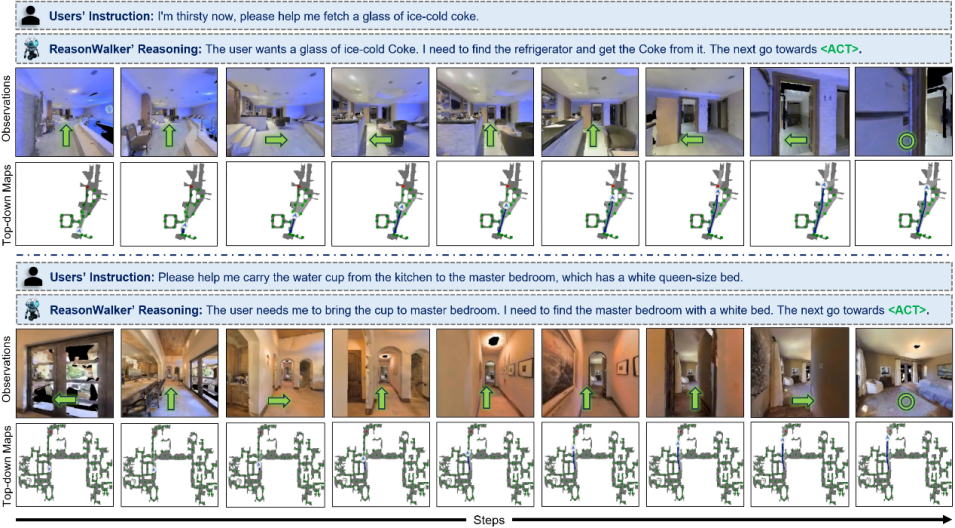
Schematic of Embodied Navigation via Iterative Implicit Instruction Reasoning (Image by SIA)
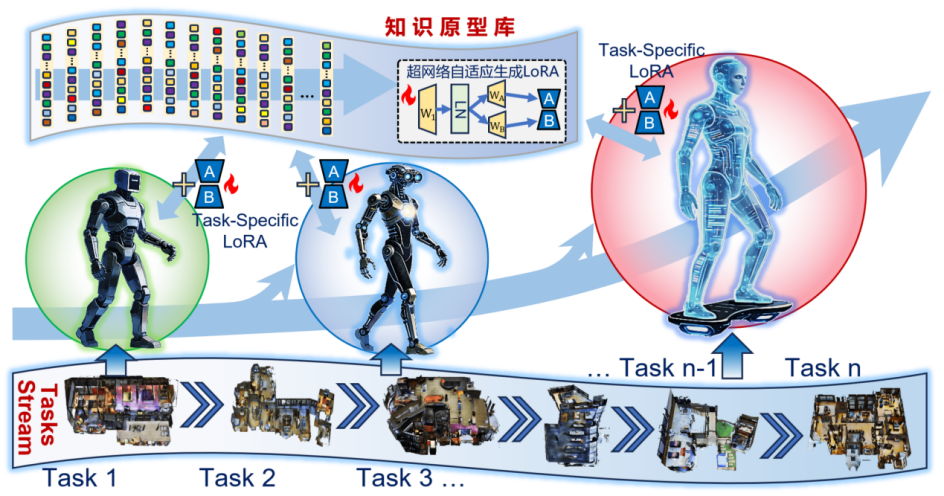
Lifelong‑Learning Architecture for Dynamically Evolving Prototype Knowledge in Embodied Navigation (Image by SIA)
Recently, a research team from the Shenyang Institute of Automation (SIA) of the Chinese Academy of Sciences, conducted research on intention reasoning and continual autonomous learning in embodied navigation. They proposed ReasonWalker, a navigation agent with implicit instruction reasoning capability, and EverWalker, a lifelong navigation agent with continuous knowledge accumulation and autonomous evolution capability.
Vision-and-Language Navigation (VLN) aims to enable robots to understand natural language instructions and autonomously navigate complex three-dimensional environments by integrating visual perception. It serves as a critical foundation for embodied intelligence to achieve natural human-robot interaction and autonomous decision-making, with broad application prospects in home service, intelligent manufacturing, and other fields.
The research on ReasonWalker was published in the international journal IEEE Transactions on Cybernetics under the title ReasonWalker: Reasoning Iterative Vision-and-Language Navigation with Implicit Instructions. Doctoral student WANG Xudong is the first author, and Researcher HAN Zhi is the corresponding author.
The research on EverWalker was published in the international journal IEEE Transactions on Circuits and Systems for Video Technology under the title Evolving the Prototype Journey: Lifelong Vision-and-Language Navigation with Prototype Adaptation. Intern LI Ganand doctoral student WANG Xudong are co-first authors, and Researcher HAN Zhi is the corresponding author.
Existing VLN methods primarily rely on explicit, step-by-step instructions and struggle to truly understand users’ high-level intentions. To address this issue, the research team proposed a new reasoning-iterative navigation paradigm and the ReasonWalker navigation model, extending robot navigation from traditional “path instruction following” to intention understanding and autonomous reasoning for user needs.
The team constructed a continuously updated explicit scene memory, converting the spatial structures, object semantics, and regional associations acquired during long-term navigation into reusable scene knowledge. By further leveraging the capabilities of pre-trained large models, they performed unified modeling and joint inference over user instructions, real-time visual observations, and scene memory, forming a complete cognitive closed loop of “intention understanding—scene association—target inference—action decision-making.” This enables navigation robots to move beyond knowing how to go, toward understanding why to go, determining where to go, and autonomously deciding how to get there.
To address the core challenge of long-term autonomous robot operation, the team explored breaking the traditional paradigm of “one-time training, fixed capabilities” to achieve lifelong autonomous evolution with continuous knowledge accumulation and capability enhancement. They proposed a new lifelong vision-and-language navigation paradigm and designed the EverWalker lifelong navigation agent, enabling robots to continuously absorb new experiences in dynamically changing environments while retaining and reorganizing previously acquired knowledge.
The team constructed a dynamically evolving prototypical navigation knowledge space, condensing transferable navigation experience from multiple scenarios into knowledge prototypes that can automatically expand and iterate as new scenarios arise, thereby enabling cross-scenario knowledge accumulation and reuse. Through a prototype-conditioned hypernetwork, the agent retrieves and combines relevant knowledge based on real-time observations, dynamically generating operational parameters adapted to the current scenario and task state, thus completing adaptive adjustment without prior knowledge of task types.
The research team has long focused on robot embodied intelligence. It aims to enhance robots’ capabilities of autonomous perception, reasoning, decision‑making and continual learning in open, dynamic, long‑term operating environments. The team has kept producing original research achievements in robotic embodied navigation and embodied manipulation. Notably, the proposed algorithms including Uni‑Walker, AlldayWalker and SkillsCrafter have been accepted by top international conferences such as ICLR 2026 and AAAI 2026.

