

Research Progress
Weight-Adaptive Physics-Constrained AI Predicts Long-Term Reservoir Pressure from Scarce Data
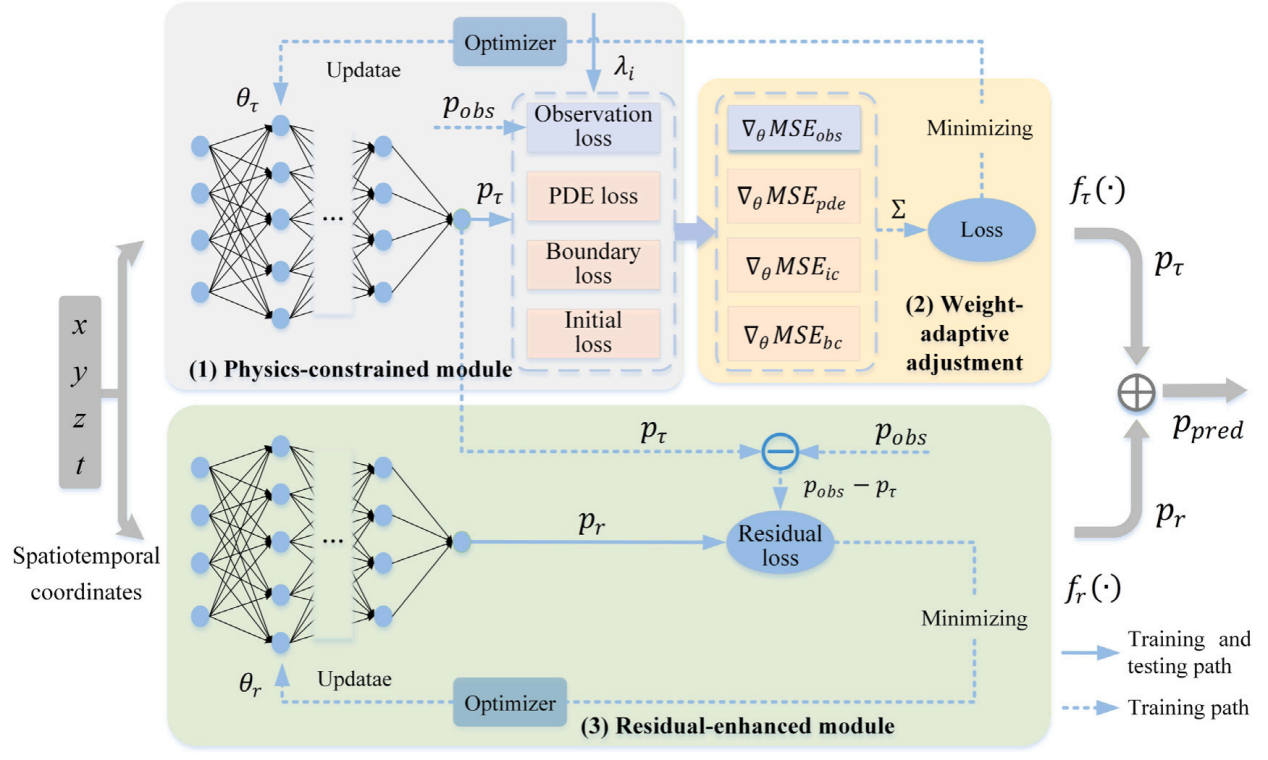
Schematic of the weight-adaptive residual-enhanced physics-constrained machine learning architecture (Image by SIA)
Reservoir pressure is a key parameter for reservoir property evaluation and production forecasting, and its accurate prediction is of great significance for optimizing development plans and production decisions. However, field monitoring of reservoir pressure requires substantial financial and time costs, and the observation data actually available are usually very scarce. Under such conditions, purely data-driven models are highly prone to overfitting and exhibit poor generalization performance. Meanwhile, conventional physics-informed neural networks (PINNs) rely heavily on manually specified loss weights and struggle to handle the incompleteness of physical mechanisms caused by observation noise and measurement errors, thus constraining the effectiveness of reservoir pressure prediction.
To address the technical bottleneck of long-term dynamic reservoir pressure prediction in small-sample scenarios, a research team from the IndustriaI Control Network and System Department of the Shenyang Institute of Automation(SIA), Chinese Academy of Sciences, has proposed a weight-adaptive residual-enhanced physics-constrained machine learning framework (WR-PCML), which can achieve accurate prediction of the long-term spatiotemporal evolution of reservoir pressure from short-term, small-sample data.
This work was published in the international journal Engineering Applications of Artificial Intelligence under the title Weight-adaptive residual-enhanced and physics-constrained machine learning framework for reservoir pressure prediction in small data regime. Doctoral student HE Yunpeng from the SIA is the first author, and Associate Professor CHENG Haibo and ProfessorZENG Peng are the corresponding authors.
The team first constructed a physics-constrained machine learning module that embeds seepage-flow governing equations, boundary conditions, and initial conditions as loss terms into the neural network training process, thereby alleviating overfitting under small-data conditions. Secondlythey proposed a weight-adaptive adjustment strategy based on multi-objective optimization, which dynamically optimizes the weights of each loss term by solving a quadratic programming problem, enabling the gradients of various constraints to be collaboratively optimized along a unified descent direction and eliminating performance bias caused by manual parameter tuning. Finally, they designed a residual enhancement module that uses an auxiliary neural network to learn and compensate for the systematic residual between observation data and physics-constrained predictions, effectively overcoming model mismatch caused by incomplete physical mechanisms and measurement errors.
The research team conducted validation experiments on two-dimensional and three-dimensional heterogeneous reservoir seepage cases. The results showed that WR-PCML performs excellently under small-data conditions: for 2D pressure prediction, the relative L₂ error was reduced by 40.63% compared with TgNN and by 88.55% compared with a purely data-driven ANN; for 3D pressure prediction, the relative L₂ error was reduced by 25.81% compared with TgNN and by 78.80% compared with ANN.
In long-term extrapolation prediction, WR-PCML maintained the lowest prediction residual at all time steps, and error accumulation over time was significantly suppressed. Even when the physical mechanism was perturbed by noise to varying degrees, the model still exhibited strong robustness, providing a reliable pressure prediction method for new or underdeveloped oilfields with limited observation data.

