

Research Progress
Laser-Controlled Bubble Microrobots Break Free from 2D Interfaces for 3D Manipulation
Recently, a research team from the Shenyang Institute of Automation (SIA) of the Chinese Academy of Sciences, proposed a method for multidimensional motion and manipulation of optothermal bubble microrobots based on remote laser control, providing an entirely new technological approach for three-dimensional microscale manipulation, microenvironment construction, and related scenarios.
Microrobots capable of flexible three-dimensional spatial manipulation hold broad application prospects in fields such as microfluidics, biochips, and targeted drug delivery. However, conventional bubble-based microrobots are typically confined to two-dimensional motion at solid–liquid interfaces. Breaking through interfacial constraints to achieve free three-dimensional manipulation in liquid environments has long been a key bottleneck in this field.
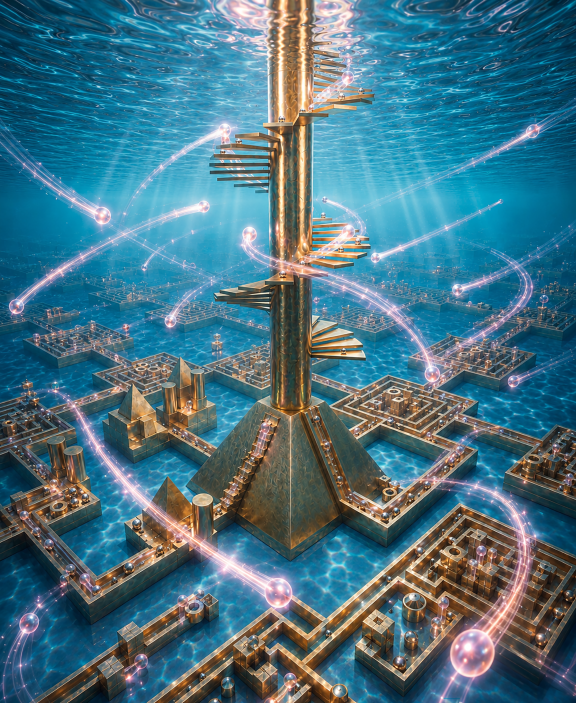
Schematic diagram of optothermal bubbles achieving multidimensional motion (SIA)
The research team placed optothermal bubbles in dimethyl silicone oil and discovered that they exhibited novel motion characteristics. The bubble robots acquired three new locomotion capabilities.
Firstly, remote attraction—a single laser beam can simultaneously attract and aggregate one or more distant bubbles; secondly, obstacle surmounting—the bubbles can autonomously climb slopes and traverse steps, flexibly navigating complex three-dimensional terrains;thirdly, levitation control—the bubbles can autonomously rise within the liquid and be re-captured and guided by the laser during ascent, thereby achieving true three-dimensional free motion in space and breaking free from interfacial confinement.
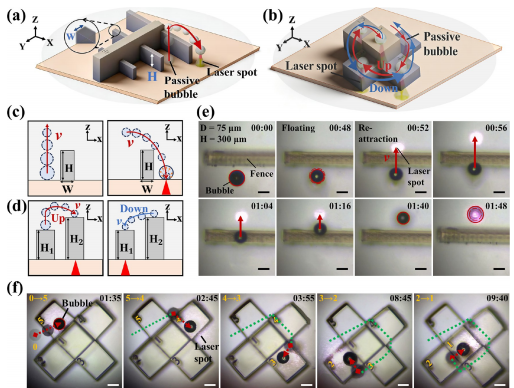
Bubbles detach from the microfluidic chip surface and move through three-dimensional structural space, breaking interfacial confinement (Image by SIA)
The proposed method upgrades bubble microrobots from “planar porters” to “three-dimensional manipulators.” The research team further utilized these bubble robots to push microspheres, achieving precise three-dimensional positioning, collection, and assembly of microspheres on slopes and microstructures of varying heights.
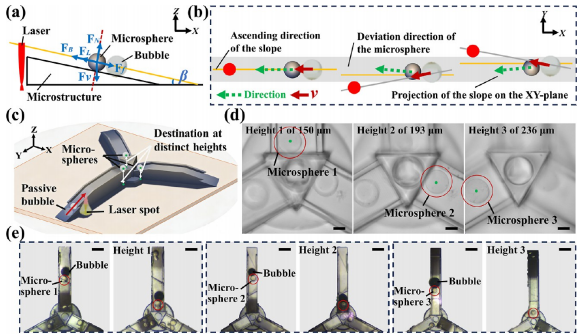
Bubble microrobots achieve three-dimensional manipulation and assembly of microspheres (Image by SIA)
This research was published in the international journal ACS Applied Materials & Interfaces under the title Multidimensional Motion and Manipulation of Optothermal Bubble Microrobots in Dimethyl Silicone Oil via Remote Laser Control. Doctoral student ZHOU Yuting from the SIA and DAI Liguo from Inner Mongolia University of Technology are co-first authors, and Professors JIAO Niandong and LIU Lianqing are corresponding authors.
The research team has long focused on micro/nanorobots and their manipulation technologies, actively promoting the interdisciplinary integration of micro/nanorobots with biomedicine, advanced manufacturing, and other fields. This research was supported by the National Natural Science Foundation of China, the National Key Research and Development Program.

