

Research Progress
New Hybrid Ontology Method Resolves Semantic Conflicts Across Manufacturing Systems
As intelligent manufacturing evolves toward flexibility, networking, and digital twins, systems such as ERP, MES, PLM, and IIoT continuously generate multi-source heterogeneous data. Because these systems are built independently, the same manufacturing object may differ in naming, hierarchy, granularity, and logical constraints across systems, readily causing semantic fragmentation and structural conflicts that constrain cross-system interoperability and manufacturing collaboration.
To address this issue, a research team from the IndustriaI Control Network and System Department of the Shenyang Institute of Automation(SIA), Chinese Academy of Sciences, has proposed a consistency-preserving hybrid ontology reconstruction method (HMOR).
The related work was published in the international journal Robotics and Computer-Integrated Manufacturing under the title Consistency-preserving hybrid ontology reconstruction for heterogeneous manufacturing ontologies.Associate Professor Wan Guangxi of the Shenyang Institute of Automation is the first author, and Professor ZENG Peng is the corresponding author.
Existing ontology-based approaches mostly focus on local matching and post-hoc repair, making it difficult to simultaneously ensure global structure, logical consistency, and semantic integrity.This method uses a core manufacturing ontology (CMO) as the semantic hub, integrating semantic mapping, structural normalization, incremental consistency verification, and minimal repair into a unified workflow to promptly identify and resolve conflicts. The CMO is constructed according to the principle of “minimal sufficiency,” providing a unified representation of key concepts such as product, process, equipment, and resources while preserving specialized knowledge that is difficult to map accurately. Each source ontology only needs to be mapped to the CMO, reducing integration complexity from quadratic to linear and enhancing scalability for large-scale manufacturing systems.
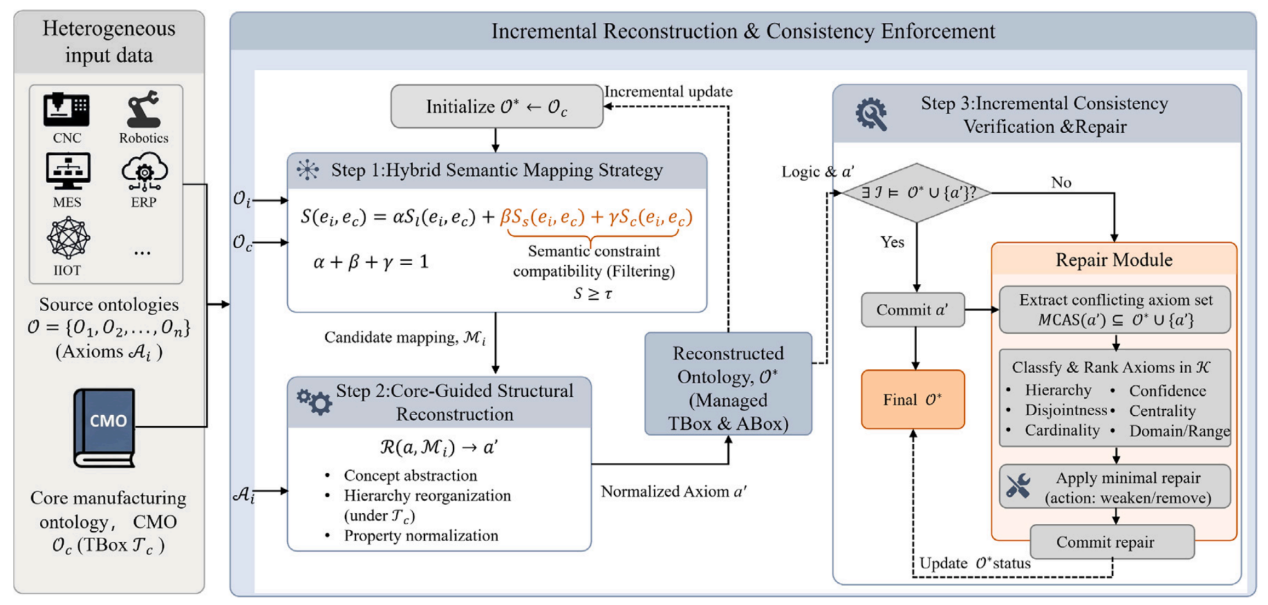
Overall workflow of the consistency-preserving hybrid ontology reconstruction method (Image by SIA)
The research team constructed the core manufacturing ontology following the principle of “minimal sufficiency,” establishing fundamental concepts including product, process, operation, resource, equipment, material, order, and location, and referencing the ANSI/ISA-95 standard and the Industrial Ontology Foundry (IOF) core framework to provide a unified representation of key entities and their relationships in manufacturing execution processes.
For specialized knowledge that cannot be accurately mapped to core concepts, HMOR does not force the establishment of equivalence relationships; instead, it preserves such knowledge as independent subtrees or metadata extensions attached to the closest mapped parent node, thereby maintaining global structural stability while minimizing loss of specialized semantics.
Different source ontologies are mapped separately to the core manufacturing ontology, avoiding the extensive pairwise matching between source ontologies required by traditional methods. This reduces the scale of multi-source mapping from quadratic to linear and enhances the method’s scalability for large-scale manufacturing systems.
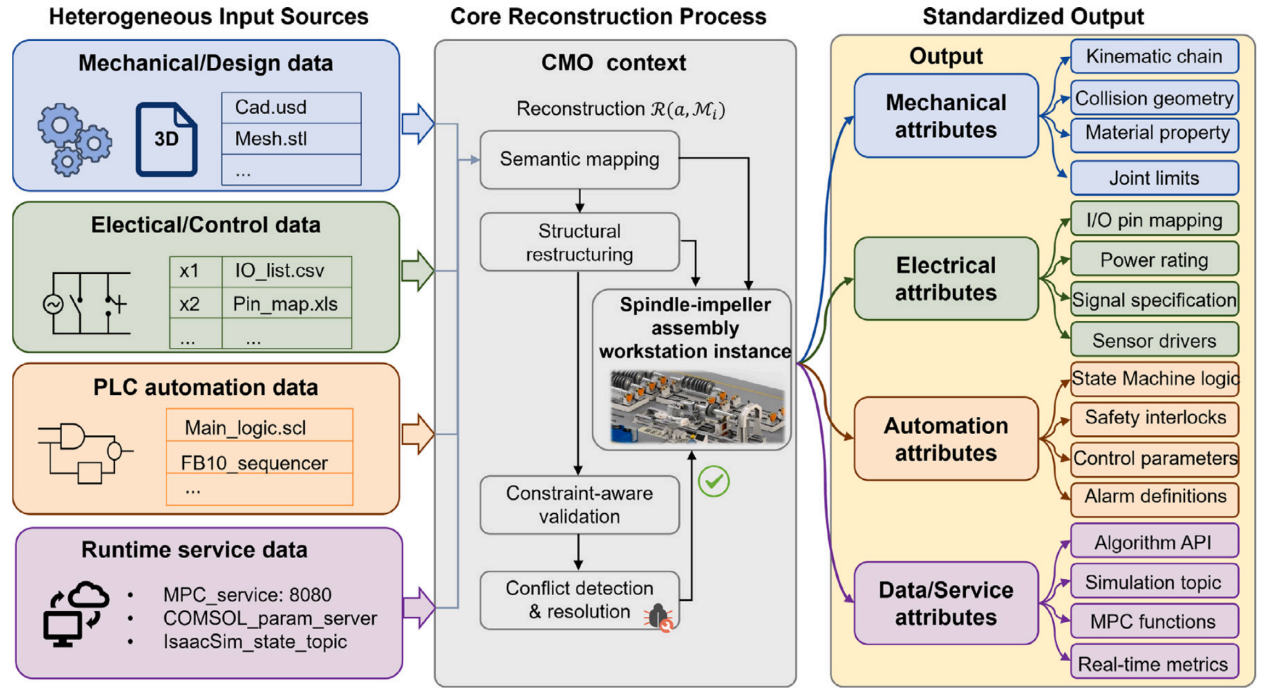
Cloud–edge–device semantic integration architecture for a flexible assembly line (Image by SIA)
The research team selected IOF-related manufacturing ontologies and the MASON manufacturing ontology to construct experimental datasets, and compared HMOR with post-hoc repair, mapping-only, and greedy repair methods. Under standard experimental conditions, HMOR achieved a consistency rate of 88.0%, a conflict repair success rate of 95.5%, a reconstruction completeness of 99.1%, and a conflict loss rate of only 1.07%, with an end-to-end runtime of approximately 0.50 seconds in the simulation environment, achieving a favorable balance among logical consistency, semantic preservation capability, and computational efficiency.
The team also constructed a cloud–edge–device collaborative deployment architecture: the cloud deploys a unified ontology database and digital twin services, the edge performs industrial protocol conversion and semantic routing, and the device layer is responsible for physical production execution, enabling unified semantic connectivity among robot workstations, PLCs, MQTT/ROS 2 communication topics, and digital model services.

