

Research Progress
New Wearable Microneedle Sensing Platform for Dopamine Detection Developed by SIABicatalytic Nanozyme Patch Enables Painless Dopamine Monitoring
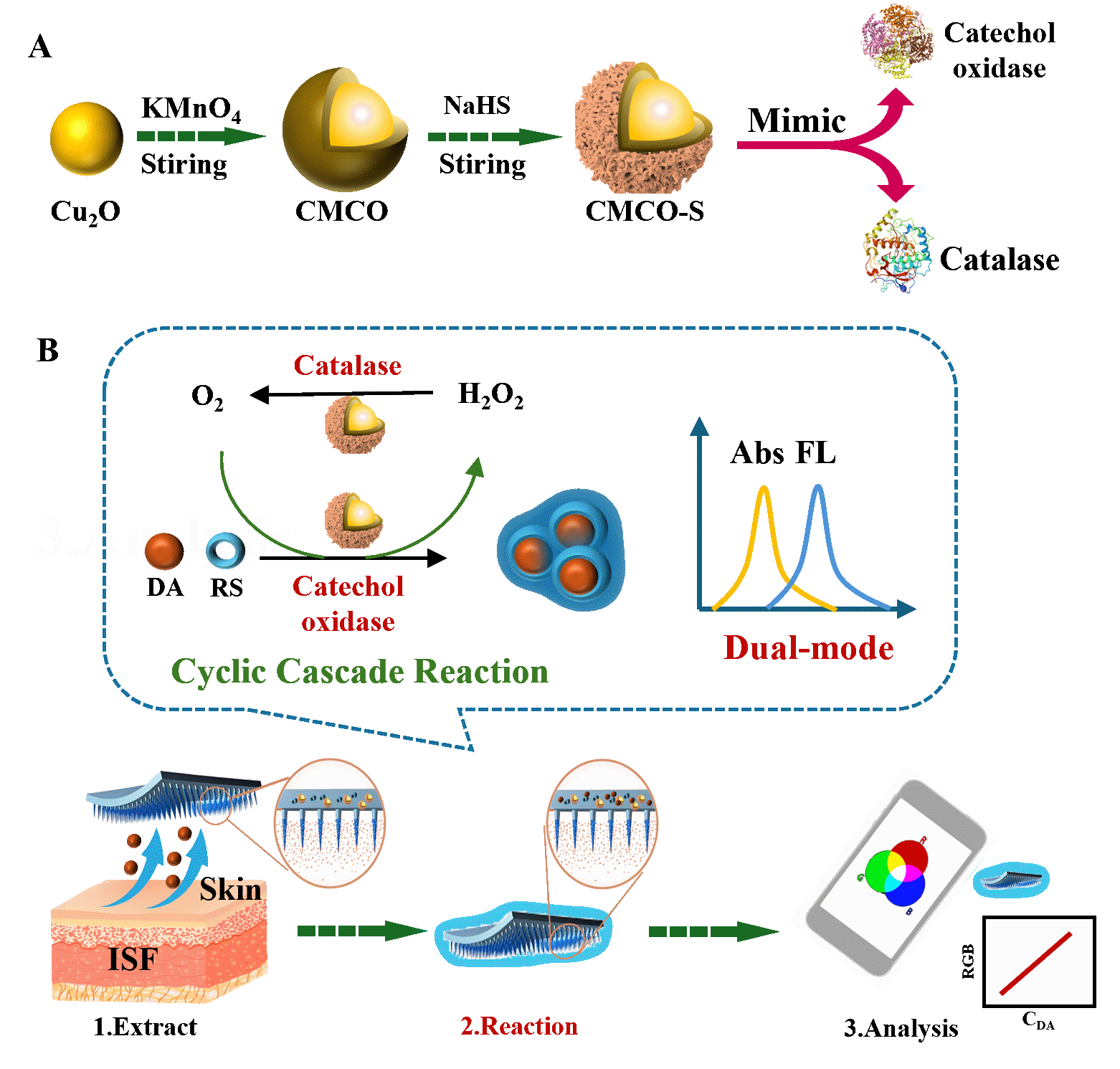
Schematic diagram of microneedle wearable sensing platform (Image by SIA)
As a key neurotransmitter, fluctuations in dopamine concentration are closely associated with a variety of neurological disorders, including Parkinson’s disease and depression. Current clinical dopamine detection largely relies on invasive procedures such as venipuncture and cerebrospinal fluid puncture, which are associated with painful sampling, an inability to perform real-time continuous monitoring, and difficulty in long-term home tracking.
Meanwhile, conventional wearable sensing devices suffer from insufficient sensitivity, weak anti-interference capability in physiological environments, and a single signal amplification mechanism.
Recently, a research team from the Robotics Laboratory, Shenyang Institute of Automation (SIA) of the Chinese Academy of Sciences, has made progress in the field of wearable biosensing. Addressing the industrial bottleneck of achieving minimally invasive, real-time, highly sensitive, and accurate detection of dopamine in human skin interstitial fluid, the team innovatively constructed a wearable microneedle sensing platform integrated with a bicatalytic nanozyme, opening up a new technological pathway for dynamic neurotransmitter monitoring, early screening of neurological diseases, and home-based intelligent health monitoring.
The related findings were published in the international journal Biosensors and Bioelectronics, under the title Wearable microneedle patches integrated with a bicatalytic nanozyme for self-cascade amplified dopamine sensing. Assistant Researcher LI Meini of the SIA is the first author of the paper, and Researcher LI Mi et al. are the corresponding authors.
The research team designed and synthesized a sulfur–manganese co-doped copper-based nanozyme (CMCO-S) that possesses both catechol oxidase-like and catalase-like activities. By constructing an H2O2/O2H₂O₂/O₂ self-circulating cascade reaction system, the researchers achieved in situ regeneration of oxygen and dual amplification of the detection signal. On this basis, the team embedded the nanozyme system into a biocompatible hydrogel microneedle array, developing a wearable microneedle patch that integrates interstitial fluid extraction with in situ visual analysis.
Multiple groups of in vitro skin simulation control experiments demonstrated that this microneedle sensing platform significantly reduces the limit of detection while maintaining excellent anti-interference capability in complex physiological fluid environments. It also provides stable detection signals, rapid response speed, and combines the advantages of being minimally invasive, painless, real-time visualizable, and suitable for long-term wear.

