

Research Progress
K2MUSE: Multimodal Walking Dataset Bri dges Lab-to-Real-World Gap for Rehabilitation Robots
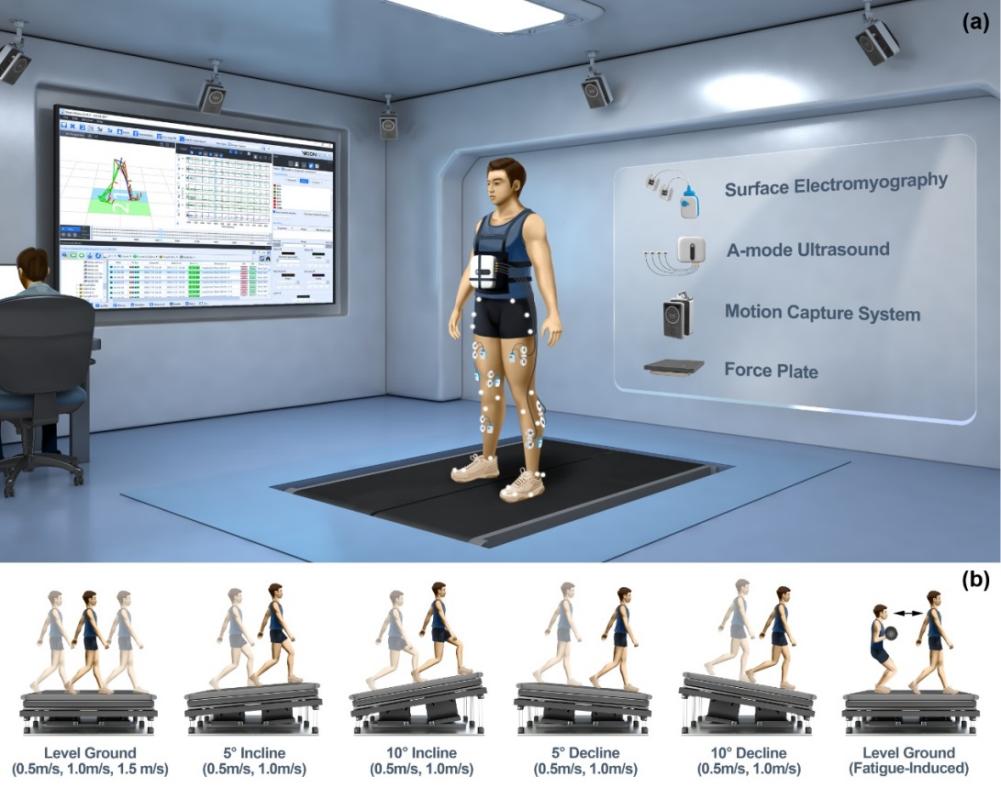
Simulation scene of experiments carried out in biomechanics laboratory (Image by SIA)
Currently available public gait datasets have clear limitations: most collect only single motion or EMG signals, lacking muscle deformation data; experiments cover only level-ground walking at constant speed, missing real-world conditions such as slopes and variable speeds, and do not consider practical interference such as muscle fatigue and sensor drift. As a result, assistive robot algorithms trained on such data suffer from insufficient accuracy when deployed.
To address these issues, ressearch team from the Shenyang Institute of Automation (SIA), Chinese Academy of Sciences, in collaboration with researchers from other universities, multiple university teams, has have released an open-source multimodal lower-limb walking dataset named K2MUSE.
This standardized dataset synchronously integrates four types of signals—kinematics, kinetics, electromyography (EMG), and A-mode ultrasound—addressing the shortcoming of existing gait datasets that are detached from real-world usage scenarios, and providing an authoritative and universal foundational resource for the development of intelligent rehabilitation exoskeletons and prostheses, as well as for human biomechanics research.
The related findings were published in The International Journal of Robotics Research, a leading international journal in robotics, under the title K2MUSE: A human lower-limb multimodal walking dataset spanning task and acquisition variability for rehabilitation robotics. Doctoral student LI Jiwei from the Shenyang Institute of AutomationSIA is the first author, and Professors ZHAO Xingang and ZHANG Bi are the corresponding authors.
The entire platform enables millisecond-level synchronous acquisition of multiple devices, with synchronization accuracy verified through a dual-validation approach: an optical motion capture system collects joint motion data, a treadmill embedded with force plates records ground reaction forces, wireless surface EMG devices capture muscle electrical signals, and a wearable ultrasound device monitors real-time muscle deformation. EMG and ultrasound signals complement each other, enhancing the stability of motion recognition algorithms.
To closely approximate real-world usage scenarios, the team designed various walking conditions covering daily terrain such as level ground, ascending/descending slopes, and different walking speeds. Additionally, three types of interference trials simulating clinical and home-use scenarios were introduced—mimicking signal disturbances caused by muscle fatigue, sensor offset, and donning/doffing variability—to train disturbance-resistant adaptive control algorithms.
The team conducted multidimensional reliability validation, demonstrating that the dataset exhibits small temporal alignment errors and good repeatability of motion trajectories, and shows high consistency compared to similar international datasets, underscoring its general research value. The researchers trained an end-to-end control algorithm on the dataset and tested it on a self-developed hip-assistive exoskeleton. The exoskeleton was able to adapt autonomously to various terrains and effectively reduce the metabolic cost of human walking, validating the practical value of the dataset.
The K2MUSE dataset is now officially online, with documentation, demonstration videos, and code repositories simultaneously released as open access. Researchers worldwide can visit https://k2muse.github.io/ or search for the dataset name on Kaggle to access all resources.
Moving forward, the team will continue to expand the dataset by adding samples of daily activities such as sit-to-stand transitions and stair walking, incorporating gait data from patient populations, and simultaneously collecting human motion information while wearing exoskeletons. This will further refine the standardized multimodal gait resource system and continuously advance the translation of intelligent rehabilitation robots from the laboratory to clinical and home settings.

