

Research Progress
A Statistically Informed Neural Network Enables Interpretable and Accurate Industrial Sensing Under Limited Data
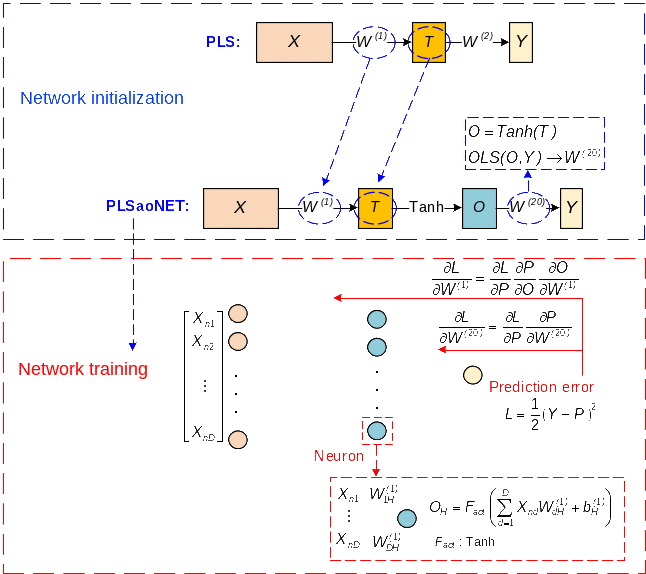
Schematic diagram of the PLSaoNET model(Image by SIA)
The realization of intelligent manufacturing in the process industry relies on real-time, accurate perception of key parameters during production. However, industrial sites commonly face challenges such as scarce labeled samples, strong noise interference, and complex nonlinear relationships. To address this issue, the LIBS team from the Industrial Control Network and System Department of the Shenyang Institute of Automation (SIA) of the Chinese Academy of Sciences, has proposed a partial least squares-assisted optimization network, termed PLSaoNET.
The related work was published in Engineering, the official journal of the Chinese Academy of Engineering, under the title PLSaoNET: A Generalized ANN Model Under PLS Statistical Constraints for Industrial Sensing.
Traditional partial least squares (PLS), a statistical method, offers strong interpretability but can only fit linear relationships, whereas neural networks possess powerful fitting capabilities yet are difficult to reliably deploy on the process industry floor due to their black-box nature and the risk of overfitting.This method leverages a PLS statistical model to provide neural networks with initialization weights that carry clear physical meaning, transforming network training from blind searching into direction-guided optimization and achieving high-accuracy, interpretable nonlinear network modeling under small-sample conditions.
The research team rigorously validated the proposed method in two typical industrial scenarios: online monitoring of iron concentrate slurry grade based on laser-induced breakdown spectroscopy (LIBS) technology, and diesel quality assessment based on near-infrared spectroscopy (NIR). The results showed that PLSaoNET delivered the best modeling accuracy and generalization performance. Furthermore, visualization of the hidden-layer weights revealed the intrinsic reasons behind PLSaoNET’s superior results.
Currently, this method has been deployed in the LIBS slurry composition analyzer at a mineral processing plant, enabling online, real-time monitoring of iron concentrate grade and providing reliable technical support for intelligent sensing in complex industrial scenarios.
This research was supported by the National Natural Science Foundation of China and the Liaoning Liaohe Laboratory research program.

