

Research Progress
PAG-DAF: Power-Aware Graph Adaptation for SPND Fault Detection
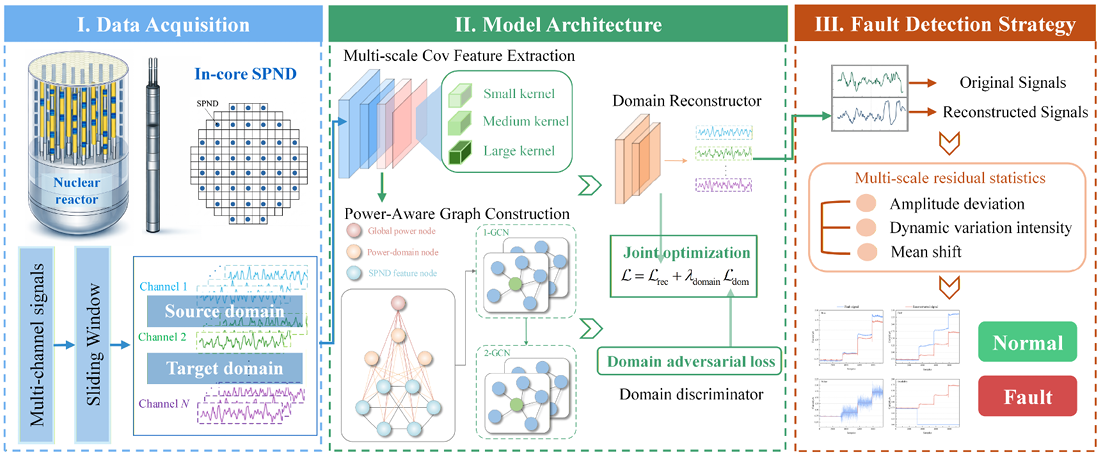
PAG-DAF Fault Detection Framework for Variable Power Operating Conditions
Self-powered neutron detectors (SPNDs) are core devices for reactor core power monitoring in nuclear power plants, and the signals they collect directly impact unit operation control and safety protection. These sensors operate in complex working conditions over extended periods, where normal fluctuations in operating conditions and equipment fault characteristics are easily confused. Fault detection across variable power conditions has long been a technical challenge in the industry.
To address this issue, a research team from the Industrial Control Network and System Department at the Shenyang Institute of Automation (SIA), Chinese Academy of Sciences, has proposed a Power-Aware Graph Domain Adaptation Framework (PAG-DAF) tailored for variable power conditions.
The method captures the dynamic evolution patterns of multi-channel SPND signals through multi-scale temporal feature extraction, constructs a graph structure integrating power information to characterize temporal dependencies, sensor coupling, and power modulation effects, and combines edge-conditioned message passing with an adversarial domain alignment mechanism to learn stable and robust feature representations across variable power conditions.
Experimental results demonstrate that this method effectively mitigates the distribution shift caused by variable power conditions and significantly improves the accuracy of cross-condition sensor monitoring and fault diagnosis.
The research results were published in Expert Systems with Applications, an international journal in the field of artificial intelligence and intelligent system applications, under the title A power-aware graph domain adaptation framework for variable-power fault detection of self-powered neutron detectors in nuclear power plants. Ph.D. student TANG Zixuan from SIA is the first author, and Researcher XU Aidong is the corresponding author.

