

Events
Kick-off Conference of the National Key R&D Program of China on Quantum Science and Technology Held in Shenyang
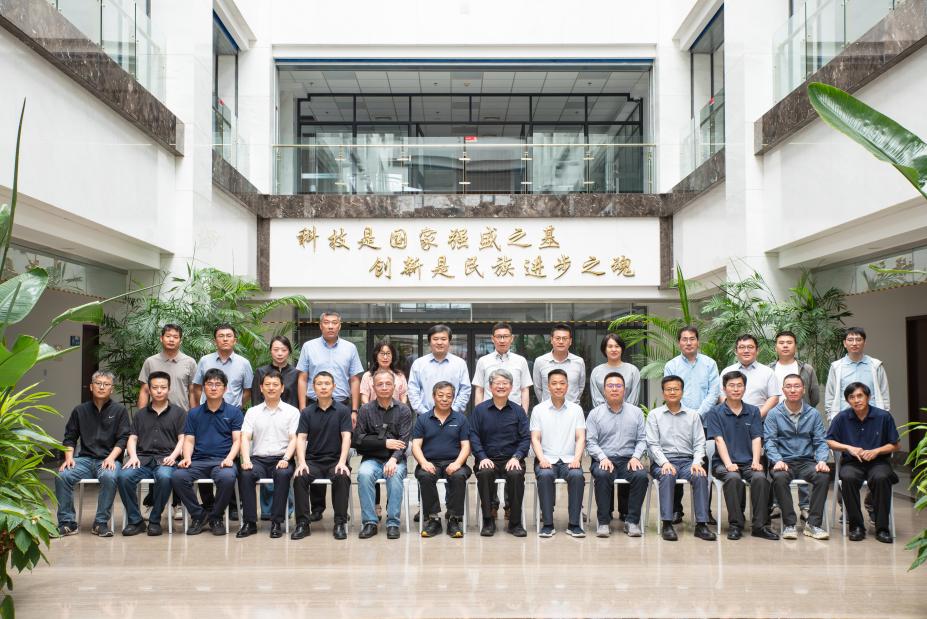
Conference Group Photo (Image by SIA)
On June 6, the kick-off conference for the project "Development of an Ultra-Low Temperature Scanning Tunneling Microscope with Vector Magnetic Field" was held in Shenyang. The project is part of the National Key R&D Program of China under the special initiative "National Quantum Science and Technology Key Materials, Devices, and Equipment R&D," and is led by Shenyang Institute of Automaiton (SIA), the Chinese Academy of Sciences.
The conference brought together more than 30 participants, including expert representatives from Renmin University of China, Jihan Scientific Instruments (Suzhou) Co., Ltd., Shanghai Liangxi Technology Co., Ltd., Xi'an Juneng Superconducting Magnet Technology Co., Ltd., and Beijing Zhongke Aikemi Technology Co., Ltd., as well as directors of related departments under SIA, andthe project principal investigator of each research task.
LIU Lianqing, the Deputy Director of SIA, noted that this project is the first National Key R&D Program project in the field of quantum technology approved in Liaoning Province during the 15th Five-Year Plan period, marking significant progress for the institute in advanced research instrumentation. This not only further consolidates SIA's research advantages in frontier areas such as quantum information and quantum control but also strongly promotes the high-quality execution and impactful implementation of cutting-edge research. The institute will fully integrate its disciplinary resources, research platforms, and talent teams to provide comprehensive support for research breakthroughs, resource allocation, and process management. By refining service measures and strengthening management responsibilities, SIA is committed to ensuring the smooth and efficient implementation and advancement of the project.
Professor ZHANG Kaifeng, Principal Investigator of the project, provided a systematic overview of the project’s overall objectives, implementation plan, task division and coordination mechanisms, research foundation, schedule, and organizational management measures. He clearly defined the key research challenges and phased tasks, and outlined the overall coordination for subsequent implementation, task integration, and outcome delivery. Following his presentation, the project principal investigator of each research task sequentially reported on their respective research goals, core content, key technical roadmaps, innovation breakthroughs, annual work plans, and expected outcomes, clearly delineating the research strategies and implementation pathways for each task.
This project focuses on the development of a scanning tunneling microscope (STM) system under extreme conditions, tackling key challenges in the development of critical components such as a dilution refrigerator, vector magnet, low-temperature scanning head, and high-frequency filtering and voltage-division modules. The project aims to break through bottlenecks in indigenous innovation in quantum science and technology, substantially advance the independent development of scientific instrumentation in China, and significantly enhance the nation's international competitiveness in the quantum technology field.
During the expert inquiry session, the project team carefully listened to and addressed the comments and suggestions from the expert panel. The team stated that they will fully incorporate and precisely implement the guidance provided by the experts, strengthen research platform support and resource coordination, focus on overcoming core key technologies. .

