

Research Progress
Researchers Propose Shank-Angle-Driven Control Method for Exoskeleton to Assist Non‑Steady Locomotion
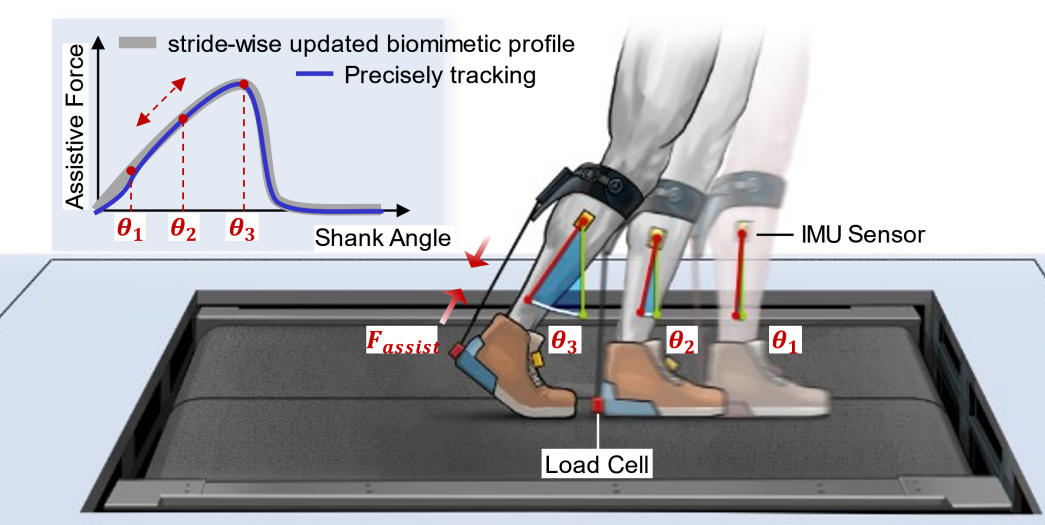
Non-stationary Motion Control Method for Exoskeleton Robots (Image by SIA)
Recently, a research team from the Robotics Laboratory at the Shenyang Institute of Automation (SIA) of Chinese Academy of Sciences, proposed an intelligent control method for lower-limb exoskeleton robots driven by the shank angle of the human leg. This approach enables the exoskeleton to continuously perceive the human motion state during non‑steady locomotion, achieving continuous matching and bionic coordination between human and robot motion.
The findings are published in the IEEE Transactions on Automation Science and Engineering under the title A Shank Angle‑Based Control System Enables Soft Exoskeleton to Assist Human Non‑Steady Locomotion. TAN Xiaowei, Associate Professor at SIA, is the first author, and Researcher ZHAO Xingang and Associate LI Ning are the corresponding authors.
Exoskeleton robots have demonstrated significant application value in structured, periodic tasks such as industrial material handling and rehabilitation assistance. However, a critical bottleneck remains for their deployment in daily life and adaptation to more complex scenarios: when humans perform irregular and rapidly changing non‑steady locomotion—such as gait transitions, speed variations, and ramp ascent/descent—conventional time‑based control methods struggle to keep pace with the real‑time dynamic motion rhythms of the human body, resulting in degraded human‑robot motion synchronization and interaction efficiency.
Grounded in human biomechanics and movement science, this method designs the shank angle as the process‑driving variable for the exoskeleton’s assistive trajectory, employing a double‑Gaussian function as the trajectory model to realize continuous synchronization of human‑robot motion. Furthermore, an online learning approach for the bionic parameters of the assistive trajectory model is proposed, relying solely on IMU sensors. By updating the model parameters on a step‑by‑step basis, the method achieves mechanical bionics of the assistive trajectory and rapidly adapts to changes in human demand.
Controllable Simulation and Induction Paradigm of Human Non-stationary Motion (Viedo by SIA)
Human Experiments on Assistance Efficiency Evaluation of Exoskeleton Robots (Viedo by SIA)
Extensive experimental validation across various non‑steady conditions—including walking and running, slope ascent/descent, motion transitions, and forward/backward speed perturbations—demonstrated that the proposed method can achieve a human‑robot motion matching rate of over 90.0%, representing a 30.8% improvement over conventional control methods.
This approach helps overcome the control challenges of exoskeleton robots under non‑steady locomotion, alleviates the limitation of restricted application scenarios, and promotes the practical deployment of exoskeletons in complex real‑world tasks.
Related research outcomes from the team have also been published in journals including T‑RO, T‑ASE, T‑IM, and T‑HMS. This work was supported by the National Natural Science Foundation of China, the National Key Research and Development Program, and the SIA Basic Research Program.

