

Research Progress
Researchers Propose Frequency-Causal Mixture-of-Experts Network for High‑Precision Spinal CT Segmentation
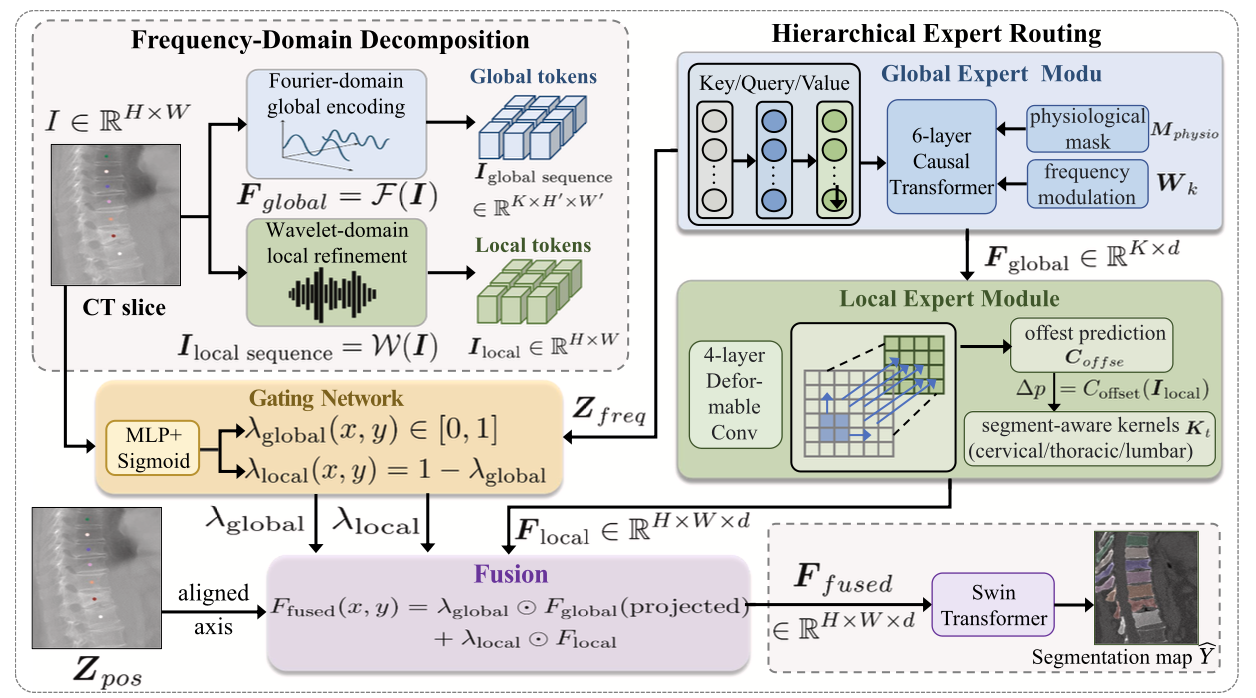
Overall Framework of FC-MoE (Image by SIA)
Automatic segmentation of spinal CT images is a foundational technique for intelligent orthopedic imaging diagnosis, preoperative surgical planning, and intraoperative navigation for spinal robotics. However, the human spine comprises tightly packed vertebral bodies with significant anatomical variations across different segments and complex local textures. To address this challenge, the research team from the Robotics Laboratory at the Shenyang Institute of Automation(SIA) of Chinese Academy of Sciences, proposed a Mixture-of-Experts network via Frequency‑Causal Reasoning (FC‑MoE), offering a novel technical solution for high‑precision automatic segmentation of complex spinal images.
The findings are published in the international journal Expert Systems with Applications under the title Mixture‑of‑Experts Network via Frequency‑Causal Reasoning for Spinal CT Segmentation. The first author is Researcher SONG Guoli of SIA, and the corresponding author is Prof. ZHANG Lei from Shengjing Hospital of China Medical University.
Existing deep learning models for automatic CT analysis, such as Transformers, generally adopt unified feature modeling approaches, which tend to cause feature confusion among different vertebrae and consequently compromise segmentation accuracy.
This study is the first to organically integrate frequency‑domain analysis, causal constraints, and a mixture‑of‑experts architecture. By decoupling global anatomical structures from local textural features in the frequency domain, introducing a causal constraint mechanism that conforms to the anatomical principles of the human spine, and employing hierarchical expert routing for adaptive feature learning across different spinal segments, the method effectively improves the segmentation performance on complex spinal CT images.
On the VerSe2020 test set, the model achieved a vertebra identification rate of 97.77%, a Dice segmentation accuracy of 92.28%, and a mean localization error of 1.12 mm, demonstrating its superior performance in automatic analysis of complex spinal CT data.
This research establishes a novel medical image analysis framework combining “frequency‑causal reasoning + mixture‑of‑experts network,” providing a new technical pathway for intelligent segmentation of chain‑like anatomical structures in CT imaging, such as the spine, ribs, and intestinal tract. It also offers significant technical support for intelligent orthopedic robot applications, spinal surgical navigation, preoperative planning, and precision medicine.
Shengjing Hospital of China Medical University provided comprehensive clinical‑chain support throughout this study, including clinical data collection, expert medical annotation, clinical validation, and application evaluation, which were critical for algorithm development, performance verification, and clinical translation.
This work was supported by the National Key Research and Development Program, the CAS Youth Innovation Promotion Association, and the Liaoning Provincial Natural Science Foundation Youth Fund.

