

Research Progress
New Dependency-Aware Method Enhances Information Freshness and Control in Industrial Systems
Flexible and customized manufacturing relies on interconnected sensing, transmission, computation, and control tasks. Downstream tasks often depend on information generated by several predecessors. A delay at any stage can therefore propagate along the task chain, reduce information freshness, and ultimately impair control responsiveness and accuracy.
Age of Information (AoI) measures data freshness by tracking the time elapsed since information was generated. Conventional AoI models, however, generally treat tasks as independent and cannot fully characterize the accumulation of delays caused by task dependencies in complex industrial processes.
To address this limitation, researchers from the Shenyang Institute of Automation (SIA) of the Chinese Academy of Sciences,developed a dependency-aware co-optimization method for sensing-transmission-computation-control (STCC) systems. The findings were published inIEEE Transactions on Mobile Computing.
The researchers introduced and defined Dependency-Aware Age of Information (DAoI) for the first time. DAoI accounts for both the sampling time of the current task and the completion times of its predecessor tasks, enabling dependency-induced delay propagation to be quantified. For a task with no predecessor, DAoI reduces to conventional AoI. The metric thus extends freshness assessment from an individual task to an entire dependency chain.
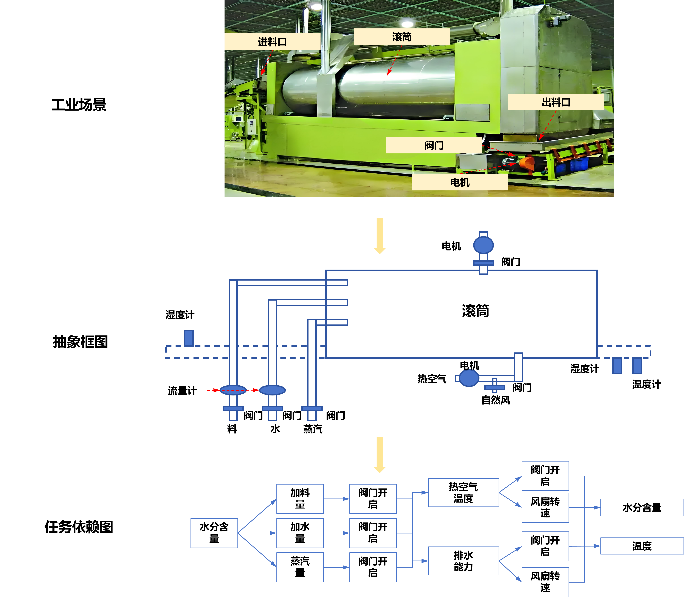
Industrial loose re-moistening process and dependency relationships among STCC tasks (Image by SIA)
Based on DAoI, the team derived a state-estimation error expression, established an analytical relationship between information freshness and control performance, and obtained a quantitative upper bound on control-performance degradation. They also designed an optimal control law based on the linear quadratic regulator, directly linking information freshness to control outcomes.
The team then formulated an STCC co-design framework for heterogeneous tasks with dependencies. The framework jointly optimizes control cost and network energy consumption under constraints involving task partitioning, transmission power, computing capacity, resource-type matching, and computing-resource allocation. The resulting mixed-integer nonlinear problem was reformulated as a Markov decision process and solved using MAPPO-DHTCO, a dependency-aware heterogeneous task and resource co-scheduling algorithm. Based on multi-agent proximal policy optimization with centralized training and decentralized execution, the algorithm learns coordinated policies for task scheduling, information updates, and resource allocation.
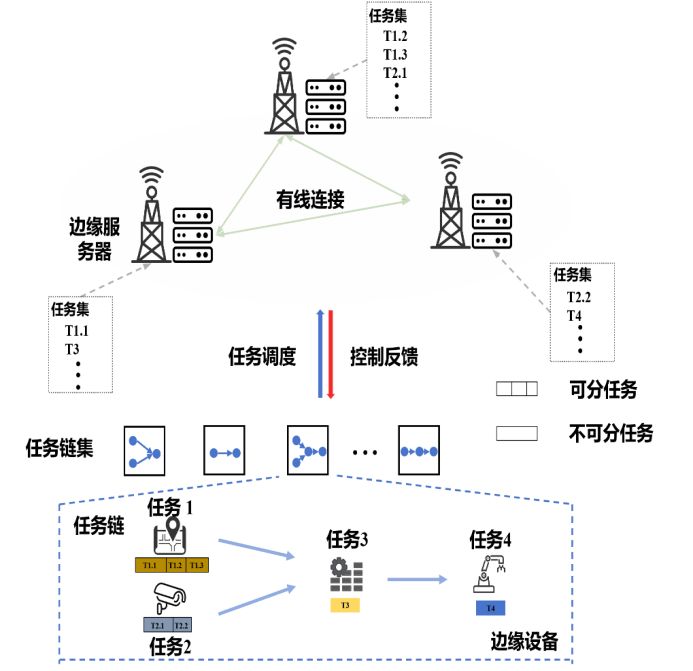
Architecture of the dependency-aware STCC co-design system (Image by SIA)
In simulations against six baseline algorithms, MAPPO-DHTCO achieved stable convergence and strong overall performance in information freshness, control cost, and network cost. Further evaluation using real physical-process data showed lower prediction errors and energy consumption, demonstrating the method's ability to handle multi-source heterogeneous data and complex task dependencies.
By integrating task dependencies, information freshness, and control performance into a unified framework, the study provides a new approach to coordinating task scheduling, resource allocation, and real-time control in flexible manufacturing and Industrial Internet of Things applications.

