

Research Progress
Novel BANet Boosts Brain-Computer Interface Signal Decoding Accuracy Dramatically
Motor imagery is one of the most widely adopted paradigms in brain-computer interface (BCI) systems. Users generate electroencephalogram (EEG) signals by imagining limb movements to control external devices. However, EEG signals are characterized by strong nonlinearity, weak feature separability, and large individual differences. A research team led by Professor ZHAO Xingang from the Shenyang Institute of Automation (SIA) of the Chinese Academy of Sciences, has proposed a novel EEG decoding network named BANet, providing a brand-new technical approach for enhancing the robustness and practical application of motor imagery BCIs.
The research results have been published in the international academic journal Neurocomputing, and the relevant code has been open-sourced on GitHub for researchers worldwide to use and improve.
The team proposed BANet, a novel EEG signal decoding network based on a bridging structure and attention mechanism.The network consists of three core modules: a convolutional ECA (Efficient Channel Attention) module, a Bridge block, and an Inception-based Temporal Convolutional Network (TCN) module. Among these, the innovatively designed "Bridge block" can extract temporal features of EEG signals from both local and global perspectives, effectively solving the problem that traditional convolutional neural networks focus only on local features while Transformer structures lack sufficient local feature extraction. Meanwhile, the integrated efficient channel attention and multi-head self-attention mechanisms can assign greater weight to highly correlated features and reduce information redundancy.
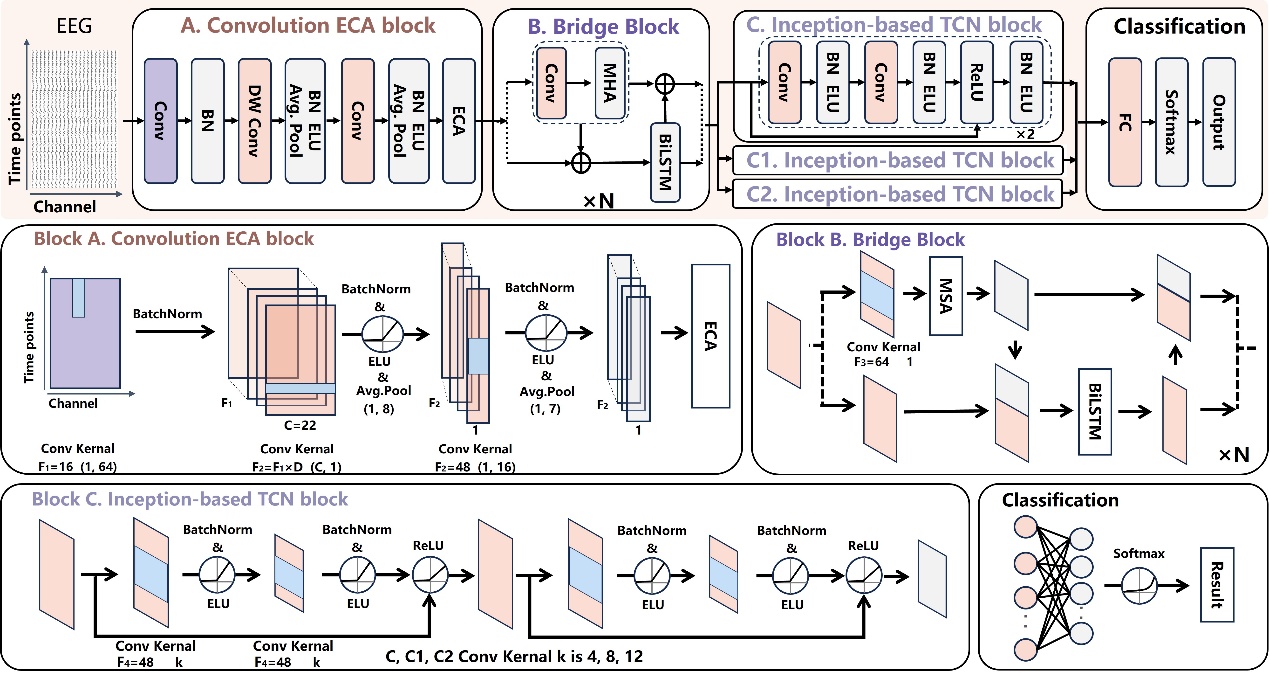
A Brain Signal Decoding Method Based on the BANet Deep Network Architecture (Image by SIA)
The research team conducted three types of experiments, within-subject, short-train, and cross-subject, on two public BCI Competition IV datasets, comparing BANet with seven representative deep learning methods, including EEGNet, EEGTCNet, and ATCNet. Results show that BANet achieved an average accuracy of 84.11% on the four-class task (left hand, right hand, foot, tongue) and 90.72% on the two-class task (left hand vs. right hand), outperforming all compared methods. Notably, the decoding performance improved significantly for subjects with low-quality EEG signals.
In practical application scenario tests, when the input signal duration was shortened to 1 second, BANet still achieved an accuracy of 68.33%, representing a maximum improvement of 16.4 percentage points over other methods. In cross-subject experiments, the model achieved average accuracies of 68.04% (four-class) and 80.86% (two-class) on unseen subjects, demonstrating strong generalization capability. Moreover, BANet has a parameter count of less than 437,100, making it a lightweight network, and its inference time per sample is only 0.42 milliseconds, making it suitable for real-time deployment on existing BCI devices.
The researchers further verified BANet's effective focus on key spatiotemporal features using visualization techniques. Heatmap analysis showed that the network can accurately activate brain regions and time windows relevant to motor imagery tasks.
"BANet demonstrates significant advantages in decoding accuracy, real-time performance, and cross-subject generalization," said ZHAO Xingang. "In the future, we will combine pre-training and other advanced methods to enable the model to adaptively select the optimal bridge structure, and conduct clinical trials to help patients use brain-computer interfaces to control robotic arms, wheelchairs, and other devices to meet their basic daily needs."

