

Research Progress
SIA Researchers Make Progress in Human-Robot Collaborative Pre-Welding Positioning for Aero-Engine Pipelines
Aero-engine pipelines are critical components of aircraft engines, consisting of bending pipes and various components such as unions, tees, and elbows. Currently, the manufacturing of aero-engine pipelines still relies on manual welding followed by shaping processes. With the increasing demand from aero-engine manufacturers for producing multi-variety, small-batch, and customized pipelines, traditional methods are struggling to meet the required precision and efficiency in pipeline fabrication.
Recently, a research team from the Manufacturing Equipmeng and Intelligent Robot Department at the Shenyang Institute of Automation(SIA) , Chinese Academy of Sciences(CAS) , has developed a pre-welding positioning system for aero-engine pipelines. This system enables flexible fixture setup for pipelines of varying dimensions.
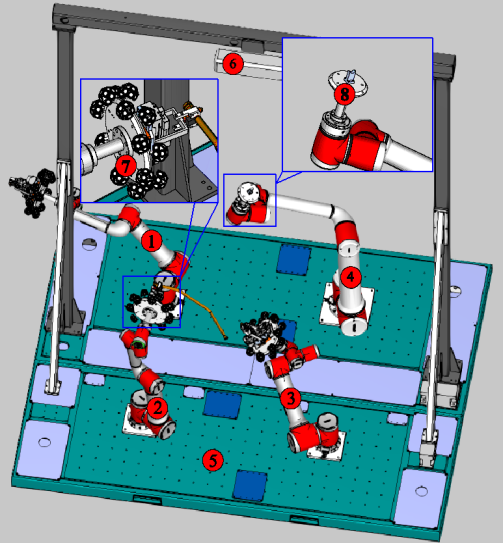
Key manufacturing stations and components of the pre-welding positioning system for aero-engine pipelines (Image by the research group)
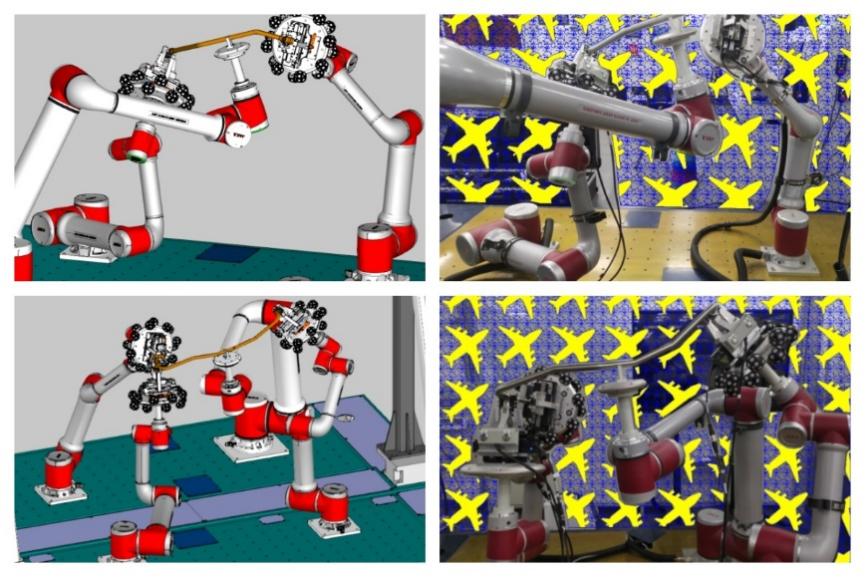
Simulation path planning and assembly/machining verification of complex pipelines (Image by the research group)
In this system, a robot grips pipeline components and moves them to the assembly position under visual guidance. Workers, assisted by robots, hold the bending pipes and assemble them between the components. Finally, a scan is required before welding to evaluate the assembly quality.
The system achieves path planning under multiple collaborative robot movements while addressing obstacle avoidance constraints, robot motion feasibility constraints, and rotational angle constraints for axisymmetric components. Simulation and experimental results demonstrate the superiority of the proposed path planning method in terms of positioning accuracy, stability, and efficiency for pre-welding pipeline assembly. Currently, this automated pipeline assembly line has been operating stably at relevant enterprises.
The research findings have been published in the Journal of Manufacturing Systems, an international journal in the advanced manufacturing field, under the title A flexible tooling system for aero-engine pipelines with complex components based on human-robot collaboration. The first author is Associate Professor ZHOU Bo from the SIA, and the corresponding author is Researcher ZHAO Jibin. This study was supported by the National Natural Science Foundation of China, the Natural Science Foundation of Liaoning Province, and other funding programs.

