

Research Progress
SIA Researchers Make Progress in Small-Sample Prediction Modeling for Surface Treatment of Aircraft Components
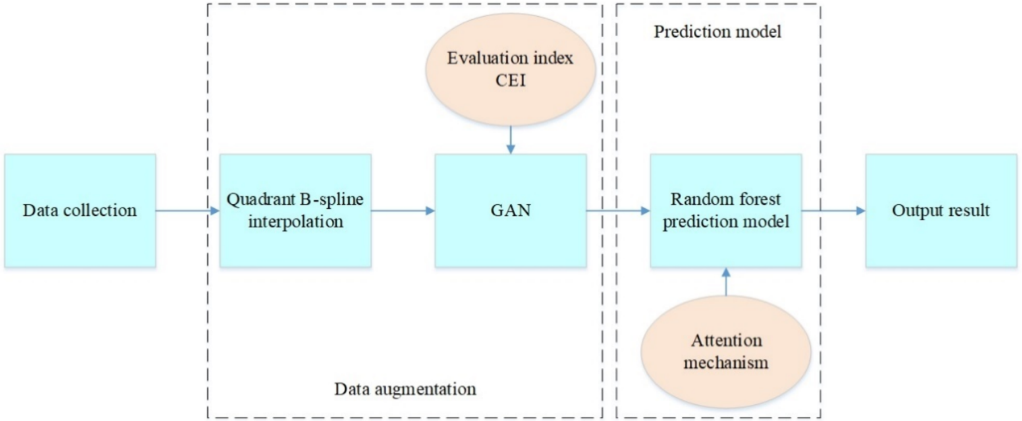
Small-Sample Prediction Modeling using Data Augmentation and Random Forest (Image by the research group)
Anodic oxidation is a core process in the surface treatment of aircraft aluminum alloy components, where the weight of the oxidation film directly affects the comprehensive surface performance of the components and the service life of aircrafts. However, this process is limited by coupled parameters and high data acquisition costs, making it difficult to build prediction models for oxidation film weight and lacking adequate decision-making support for the production optimization process.
To address these challenges, a research team from the Digital Factory Laboratory at the Shenyang Institute of Automation (SIA), Chinese Academy of Sciences (CAS), recently proposed a small-sample prediction modeling method using data augmentation and random forest. The approach optimizes both data augmentation and feature extraction to tackle difficulties in predicting key parameters under small-sample conditions.
By integrating mechanism analysis with spline interpolation and generative adversarial networks (GANs), the researchers improved the quality of augmented data. Using this augmented dataset, they constructed an oxide film weight prediction model based on attention mechanism and random forest, achieving accurate prediction of key parameters in the anodic oxidation process of aircraft components with limited samples. This provides a new approach for precise control and optimization of surface treatments.
The findings, under the title Weight prediction of the oxidation film in aircraft aluminium alloy components with small samples using data augmentation and random forest, have been published in the international artificial intelligence journal Engineering Applications of Artificial Intelligence. Associate Researcher LI Shuai is the first author, and Researcher ZHOU Xiaofeng is the corresponding author. The study was supported by the Civil Aircraft Special Project of the Ministry of Industry and Information Technology of China.

