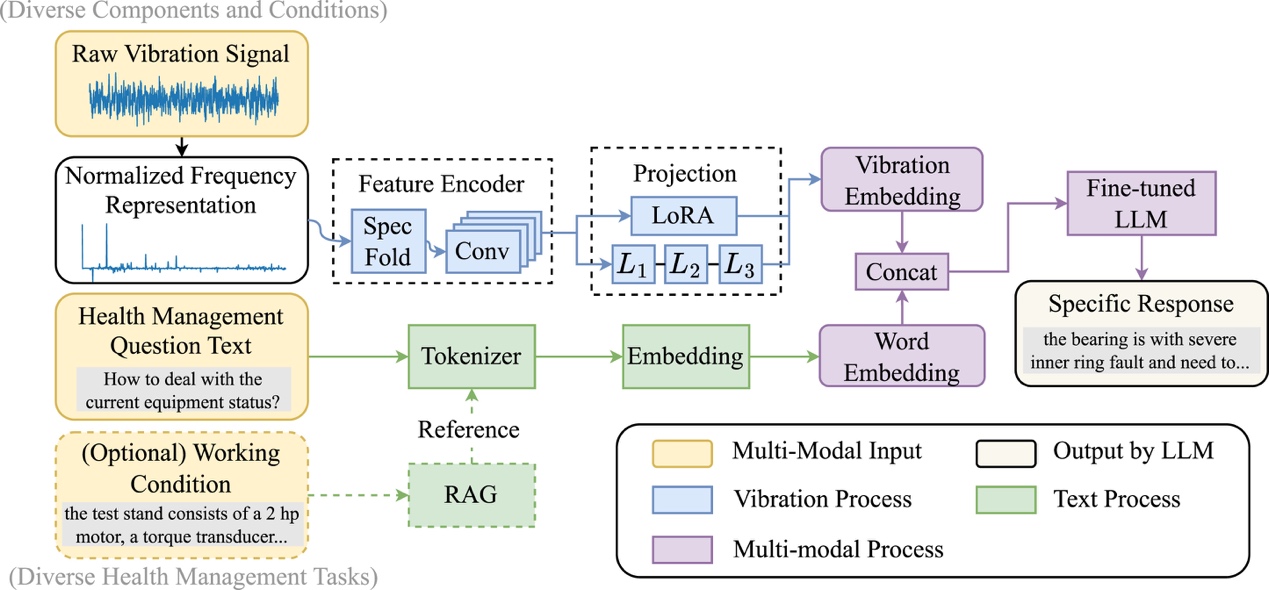
Health Management Framework (Image by the research group)
Rotating machinery constitutes critical equipment in key sectors such as energy and manufacturing, whose health status directly impacts system safety and operational reliability. Traditional fault diagnosis methods often target single components or specific operating conditions, struggling to meet the health management demands of complex and variable industrial scenarios.
Addressing this challenge, a research team from the Intelligent Inspection and Equipment Laboratory at the Shenyang Institute of Automation (SIA), Chinese Academy of Sciences (CAS), has conducted a study proposing a unified health management framework for rotating machinery based on Large Language Models (LLMs). This framework innovatively introduces a Spectral Folded Network and a Semantic Projection mechanism, enabling deep integration of vibration signals into the semantic space of the language model. It can perform multi-task reasoning—including anomaly detection, fault diagnosis, and maintenance recommendation—within a unified architecture.
The research demonstrates that this method exhibits strong generalization capability and interpretability under multi-component and multi-condition scenarios, offering a novel approach for the intelligent health management of complex industrial equipment.
These findings, under the title A unified rotating machinery health management framework leveraging large language models for diverse components, conditions, and tasks, have been published in the international artificial intelligence journal Engineering Applications of Artificial Intelligence. Haotian Peng, a Ph.D. candidate at SIA, is the first author. Corresponding authors are Researcher Wang Wei and Associate Researcher JieGao. This work received support from projects of the National Natural Science Foundation of China and the Natural Science Foundation of Liaoning Province.


